
Blog centering
Card Centering: How Graders Measure 55/45 and 60/40

Your card looks perfect. Sharp corners, clean holo, not a scratch in sight. Then you notice the left border is a little chunkier than the right, and suddenly you are squinting at a millimeter like it owes you money. Welcome to card centering.
Quick answer
Card centering compares the border widths on opposite sides of a card. Measure from the outer edge to the inner printed border, then divide the wider side by the total: 3 mm and 2 mm makes 60/40. PSA allows about 55/45 on the front and 75/25 on the back for a 10, and about 60/40 for a 9.
Key takeaways
- Centering is written as two numbers that add up to 100. Perfect is 50/50, and the bigger number always comes first.
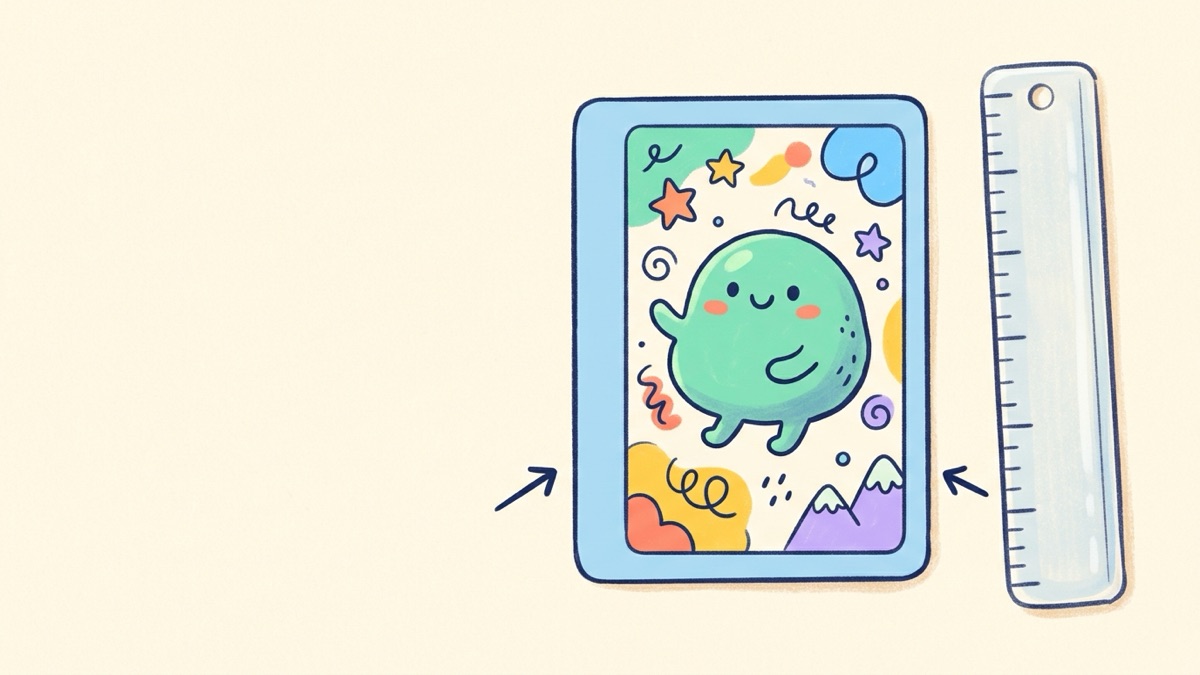
- You measure from the card's outer edge to the inner printed border on all four sides, never to the artwork.
- Graders check left/right and top/bottom, front and back, and go by the worst one.
- PSA's 10 allows about 55/45 on the front and 75/25 on the back. CGC's Gem Mint 10 uses the same limits, and its Pristine 10 needs 50/50.
- A straight, glare-free photo plus a calculator beats a ruler and a squint.
What does card centering mean?
Centering is how evenly the printed front (or back) sits on the card. If the borders on opposite sides are the same width, the card is perfectly centered, which is written as 50/50. If one side is wider, the numbers split apart: 55/45, 60/40, 70/30 and so on.
The first number is the wider border's share of the two borders combined. The second is the thinner one's share. They always add up to 100.
Every card has two directions to check: left to right, and top to bottom. PSA's standards say it compares the borders in both directions and goes by the percentage "at the most off-center part of the card." In plain words: your worse direction is your centering.
How do you calculate a centering ratio?
You only need two measurements and one division.
- Measure the left border and the right border.
- Add them together.
- Divide the wider border by that total and multiply by 100.
- That is your first number. Subtract it from 100 for the second.
Say the left border is 2.4 mm and the right is 1.6 mm. Together that is 4.0 mm. Then 2.4 divided by 4.0 is 0.60, so the card is 60/40 left to right.
Now the top and bottom. Say the top is 3.1 mm and the bottom is 2.5 mm, for 5.6 mm in total. Then 3.1 divided by 5.6 is about 0.55, so that direction is about 55/45. This card's worse direction is 60/40, so that is its centering.
Here is the part that surprises most people. For easy math, imagine the two side borders add up to exactly 4 mm:
| Centering | Wider border | Thinner border | Difference |
|---|---|---|---|
| 50/50 | 2.0 mm | 2.0 mm | none |
| 55/45 | 2.2 mm | 1.8 mm | 0.4 mm |
| 60/40 | 2.4 mm | 1.6 mm | 0.8 mm |
| 65/35 | 2.6 mm | 1.4 mm | 1.2 mm |
| 70/30 | 2.8 mm | 1.2 mm | 1.6 mm |
| 75/25 | 3.0 mm | 1.0 mm | 2.0 mm |
| 90/10 | 3.6 mm | 0.4 mm | 3.2 mm |
On that example, the gap between a front that fits a PSA 10 and one that does not is less than half a millimeter. That is why eyeballing does not cut it.
How do you measure left/right and top/bottom?
Where you put your measuring points matters more than what you measure with.
- Find the outer edge. This is the physical edge of the card.
- Find the inner border line. This is where the solid border ends and the printed frame begins. On classic English Pokemon cards, that is where the yellow border stops. It is not the edge of the artwork box, which sits further in.
- Measure all four sides. Left, right, top and bottom, each from outer edge to inner border line.
- Check more than one spot. If the print is slightly tilted, a border can be wider at the top of a side than at the bottom. Measure near both ends and use the most off-center spot, the way PSA does.
- Flip it over. On the back of a Pokemon card, measure the dark blue border around the swirl design the same way.
A plain ruler is too coarse for this, since you are hunting for fractions of a millimeter. A loupe with a printed scale, a clear centering overlay, or a straight photo you can zoom into all work much better. Our step-by-step guide to measuring centering with just your phone covers the photo route in detail.
Why does the back get 75/25?
For a 10, PSA allows about 55/45 on the front but 75/25 on the back. CGC's Gem Mint 10 uses the same pair. Neither company publishes the reason, but the logic is easy to see: the front is what faces out of the slab, and it carries almost all of a card's eye appeal. The back gets a longer leash.
The front and back are printed on opposite sides of the sheet, so they do not always line up the same way. A card can be beautifully centered on the front and noticeably off on the back, or the other way around.
The back is not a free pass, though. Look at the table below: every PSA grade from 9 down to 2 asks for 90/10 or better on the back, and on a Pokemon card the dark blue back border makes a shift easy to spot. Our guide to front vs back centering goes deeper.
What are PSA's centering standards?
These are PSA's published limits, checked on its grading standards page in September 2026:
| PSA grade | Name | Front | Back |
|---|---|---|---|
| 10 | Gem Mint | about 55/45 | 75/25 |
| 9 | Mint | about 60/40 | 90/10 |
| 8 | NM-MT | about 65/35 | 90/10 |
| 7 | NM | about 70/30 | 90/10 |
| 6 | EX-MT | 80/20 | 90/10 |
| 5 | EX | 85/15 | 90/10 |
| 4 | VG-EX | 85/15 | 90/10 |
| 3 | VG | 90/10 | 90/10 |
| 2 | Good | 90/10 | 90/10 |
| 1.5 | Fair | about 90/10 | about 90/10 |
A few details from PSA's notes are worth knowing:
- There is some wiggle room. At the grader's sole discretion, a small variance may be allowed based on the card's overall eye appeal.
- Cards grading 7 or better get a 5 percent leeway on front centering when eye appeal is good. PSA's example: a card that is otherwise a 9 and measures 65/35 on the front may still get the 9. Treat that as a bonus, not a plan, especially when you are hoping for a 10.
- The 10 got stricter. Hobby sites reported that PSA tightened the front limit for a 10 to about 55/45 in 2025. Before that it was widely quoted as 60/40, so older guides may still show the looser number.
- Off-center cards can get an OC qualifier instead of a lower number. Our PSA grading scale guide explains qualifiers and every grade in plain words.
Fun fact
PSA's standards page explains eye appeal with two Sandy Koufax cards. On the 1955 Topps card, a yellow background blends into the border, so slight off-centering barely shows. On the 1957 card, a dark background makes the border stand out, so even a card that technically measures 70/30 can look off-center and be held back.
What are CGC's centering standards?
CGC publishes its limits on its grading scale page. The big difference from PSA is the extra grade at the top.
| CGC grade | Front | Back |
|---|---|---|
| Pristine 10 | 50/50 | not listed separately |
| Gem Mint 10 | about 55/45 | 75/25 |
| Mint+ 9.5 | "exceptional centering" can lift a card here | not listed |
| Mint 9 | 60/40 | 90/10 |
| NM/Mint 8 | 65/35 | not listed |
| Near Mint+ 7.5 | 65/35 | not listed |
| Near Mint 7 | 70/30 | not listed |
| Ex/NM 6 | 75/25 | not listed |
One honest caveat: CGC's page ties the figures for Mint 9 and below to sports and non-sports cards. For TCG cards such as Pokemon, it describes handling and manufacturing defects at those grades instead of a centering number. Use the figures as a sensible guide, not a hard line. Our PSA vs CGC guide compares the two companies in full.
Other graders, briefly:
- SGC: its Pristine 10 calls for 50/50 centering.
- Beckett (BGS): Pristine 10 is widely reported to need essentially perfect 50/50 front centering, and Gem Mint 9.5 is commonly cited around 55/45 on the front. Beckett's site was offline when we checked, so treat both as reported.
- TAG: widely reported to grade with computer imaging and to publish a detailed numeric score alongside the 1 to 10 grade.
What are the most common centering mistakes?
These are the ones that trip up almost everybody at least once.
- Measuring to the artwork. The art box is not the border. Measure to where the solid border ends.
- Only checking left and right. Top and bottom count just as much, and your worse direction wins.
- Forgetting the back. A great front with a badly shifted back can still miss the grade.
- Measuring a tilted photo. A phone held at an angle squeezes one border and stretches the other, which can make a well-centered card look off, or the other way around.
- Missing a tilted print. If the print sits at a slight angle (collectors call it a diamond cut), the borders taper. Measure near both ends of each side and keep the worst reading.
- Measuring through a toploader. Thick plastic adds glare and blur right where the border edge is. Use a clean penny sleeve or no sleeve.
- Rounding in your favor. If it measures 56/44, it is 56/44. Hope is not a measuring tool.
- Treating full art cards like bordered ones. Some modern cards have art running into the border area, so there is no clean inner line. Measure to the edge of the printed frame on each side and treat the result as a rough guide.
How do you take a straight photo for centering?
A good photo turns centering into simple arithmetic. A bad one turns it into guesswork.
- Take the card out of the toploader. Bare is best; a clean penny sleeve is fine.
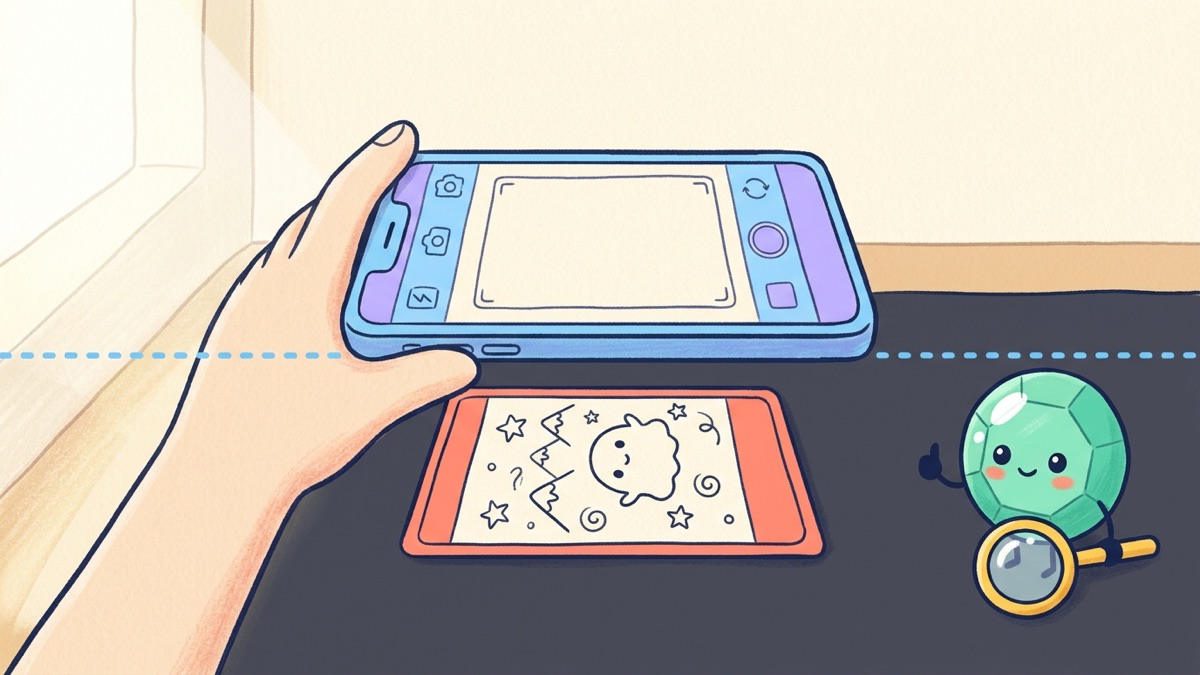
- Lay it on a dark, plain, flat surface so the card edge stands out clearly.
- Hold the phone directly above the card, parallel to the table. Turn on your camera's grid and line the card edges up with it.
- Skip the ultra-wide lens. Use the normal lens, or back up a little and zoom slightly, which keeps straight edges straight.
- Use soft, even light with no flash. Glare on a holo border hides exactly the line you need to find.
- Fill most of the frame with the card, leaving a little background around all four edges.
- Shoot the back the same way.
If you have a flatbed scanner, that works too, since it captures the card perfectly flat every time.
Try it
Drop your photo into the free card centering calculator, drag the guides to the card edges and inner borders, and see your front and back ratios against the PSA and CGC limits. It runs in your browser and your photo is never uploaded.
Does perfect centering mean a PSA 10?
No. Centering is one of four things graders check, alongside corners, edges and surface. A 50/50 card with a soft corner or a scratch across the holo will not get a 10.
What centering does give you is a fast first filter. It cannot be fixed, it can be measured exactly, and it tells you roughly the highest grade a card can reach. If the front measures 65/35, a PSA 10 is off the table, and you can decide whether grading still makes sense with our worth-it check. For the other three checks, see our step-by-step guide to how to grade Pokemon cards. The MintGrade app, coming soon, will measure centering and look at corners, edges and surface from a single photo.
The takeaway
Centering sounds technical, but it is really just two borders and a division. Measure to the inner border, not the art. Check both directions, front and back, and keep the worst number. Compare it with the PSA or CGC table, and you will know which grades are possible before a grader ever picks up the card.
MintGrade guides explain how grading works and help you decide what to submit. Only a grading company can assign a grade, and prices change daily, so check recent sold listings before you buy, sell or submit.
Questions collectors ask
What does 60/40 centering mean?
It means the wider border on one side takes up 60 percent of the two borders combined and the thinner one takes 40 percent. For example, a 2.4 mm left border and a 1.6 mm right border is 60/40.
What centering do you need for a PSA 10?
PSA's published standard for a Gem Mint 10 is about 55/45 or better on the front and 75/25 or better on the back. A PSA 9 allows about 60/40 on the front and 90/10 on the back.
Do you measure centering to the artwork or to the border?
To the border. Measure from the outer edge of the card to where the solid border ends and the printed frame begins on each side. The artwork box inside the frame is not what graders measure.
Why is back centering allowed to be worse than front centering?
PSA and CGC both allow 75/25 on the back for a Gem Mint 10, compared with about 55/45 on the front. Neither explains why, but the front is what people see in the slab, so it carries most of the eye appeal.
What is the best card centering tool?
Anything that measures border widths precisely: a loupe with a measuring scale, a clear centering overlay, or a photo-based calculator. MintGrade's free centering calculator runs in your browser and never uploads your photo.
Where these facts come from
- PSA grading standards (grades, centering and the OC qualifier): www.psacard.com/gradingstandards
- CGC Cards grading scale: www.cgccards.com/card-grading/grading-scale/
- SGC card grading scale: gosgc.com/card-grading/scale
Read next

grading basics
What Is a PSA 10? The PSA Grading Scale Explained
grading basics
How to Grade Pokemon Cards: A Step-by-Step Guide
grading companies
PSA vs CGC for Pokemon Cards: Which Should You Pick?
grading costs
Is My Card Worth Grading? A 5-Minute Check