Blog condition
Pokemon Card Conditions: NM, LP, MP, HP and Damaged
You find the card you want online, and next to the price sits a tiny code: NM, LP or MP. That little code can mean the difference between a crisp, shiny card and one that looks like it went through the laundry. This Pokemon card condition guide explains what each label really means, how to check your own cards with a lamp, and why a condition is not the same thing as a grade.
Quick answer
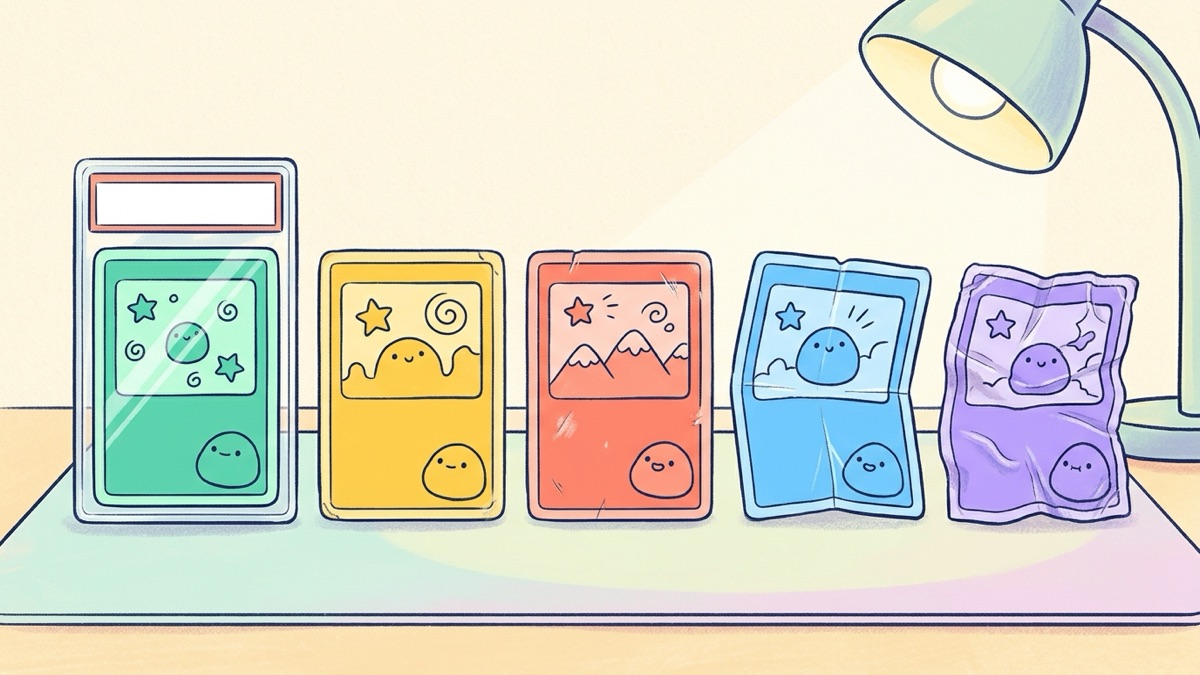
Marketplaces sort raw Pokemon cards into five conditions: Near Mint (NM, almost no wear), Lightly Played (LP, small scuffs or edge wear), Moderately Played (MP, clear wear, maybe a crease), Heavily Played (HP, heavy wear and bends) and Damaged (DMG, tears, folds or water damage). A condition is a label, not a numeric grade.
Key takeaways
- The five conditions, from best to worst, are Near Mint, Lightly Played, Moderately Played, Heavily Played and Damaged.
- TCGplayer's standards (updated March 2025) score every flaw by type and size, and each condition allows only so many points.
- A condition label is not a grade. Grading companies give a number from 1 to 10, and there is no official conversion.
- One bright light at a low angle finds most flaws: whitening on edges and corners, scratches on the surface, and dents, creases and bends.
- Each step down in condition usually means a lower price, so always compare sold prices in the same condition.
What are the five Pokemon card conditions?
Most online stores and marketplaces use the same five labels. TCGplayer, a large online card marketplace, publishes detailed Card Conditioning Standards, so this guide uses them as the reference. Its marketplace lets sellers list cards as Near Mint, Lightly Played, Moderately Played, Heavily Played or Damaged, and it does not sell cards as Mint or Gem Mint. Those words belong to grading, which we get to below.
Here is the clever part. TCGplayer sorts every flaw by type (edge wear, scratches, scuffing, dents, bends and so on) and by severity. A slight flaw counts 1 point, minor 2, moderate 4 and major 8. Each condition has a points budget, and some flaws are not allowed at all in the higher conditions.
| Condition | Code | What you will see | TCGplayer limit |
|---|---|---|---|
| Near Mint | NM | Looks nearly unplayed, maybe slight edge wear or a scratch or three | Up to 3 points, no whitening, grime or bends |
| Lightly Played | LP | Minor border or corner wear, light scuffs or scratches | Up to 6 points, small bends allowed |
| Moderately Played | MP | Clear wear, scuffing, whitening, maybe a crease | Up to 12 points |
| Heavily Played | HP | Major wear with creases, whitening and bends | Up to 24 points |
| Damaged | DMG | Tears, folds, holes, water damage, heavy curl | Beyond Heavily Played |
What does each condition look like?
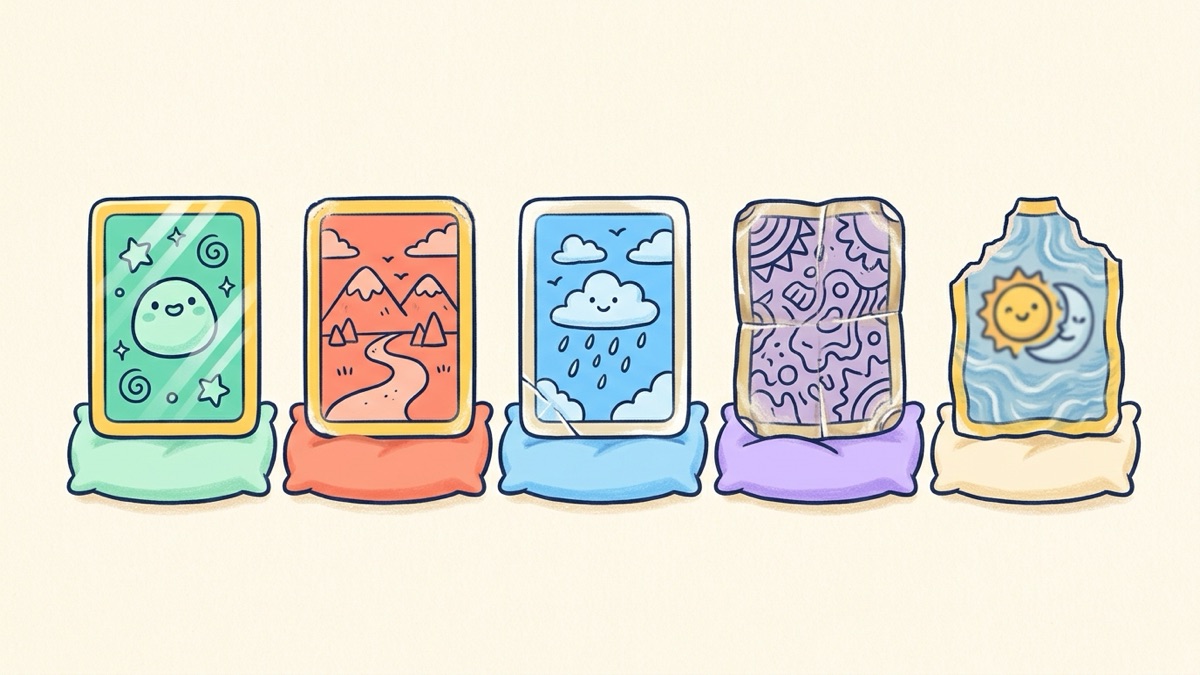
Near Mint (NM)
A near mint Pokemon card shows minimal wear from shuffling, play or handling. TCGplayer describes a nearly unmarked surface, crisp corners and unblemished edges apart from a few slight flaws, and says a Near Mint card may have slight edge wear or a scratch or three.
So Near Mint does not mean perfect. It is the top marketplace label, which means it covers everything from a flawless pack-fresh card to one with a tiny nick. Whitening where the top layer has worn through, dirt, bends and any damage are not allowed.
Lightly Played (LP)
A lightly played Pokemon card shows signs of handling or play but no significant imperfections and nothing wrong with its structure. Expect minor border or corner wear, light scuffs, a few scratches, a small dent or a touch of grime. TCGplayer even allows a minor bend, up to about 10 mm long.
Think of a card that lived in a binder and got flipped through a lot. It still looks good at arm's length. Up close, you can see it has been loved.
Moderately Played (MP)
A moderately played Pokemon card shows significant play, use or wear. It can have border wear, corner wear, scratching, scuffing, creases or whitening, in any combination. A crease is allowed here as long as it does not break the card's structure.
This is the classic "carried in a deck box for a season" card. It is still clearly the right card, just a well-used one.
Heavily Played (HP)
Heavily Played cards show a major amount of wear. Creases, whitening and bends are common, and some flaws can affect the card's structure. TCGplayer's line is that the card must still work in a sleeve for play.
Damaged (DMG)
Damaged is everything beyond Heavily Played. TCGplayer lists tears, punctures, splitting, folds, missing or unreadable text, big miscuts, ink or marker that did not come from the factory, and water damage. A card that curls up more than about 5 mm off a flat table also counts as Damaged.
Signatures, stamps and other personal markings are treated as alterations, so TCGplayer asks sellers to list those cards with photos instead of a standard condition.
How is a condition label different from a grade?
TCGplayer draws the line clearly. It calls the act of giving a card a non-numeric label "conditioning" and saves "grading" for the numeric scores given by professional grading companies.
The words overlap, which confuses people. PSA's grade names include NM (PSA 7), NM-MT (PSA 8), MINT (PSA 9) and GEM-MT (PSA 10). A marketplace "Near Mint" card is not a PSA 7, and it is not a PSA 10 either. There is no official conversion, and no one can promise what grade a raw card will get.
| Question | Marketplace condition | Numeric grade |
|---|---|---|
| Who decides? | The seller or store | A grading company such as PSA, CGC or SGC |
| Scale | Five labels, NM to DMG | 1 to 10 |
| Where the card lives | Raw, in a sleeve | Sealed in a plastic slab |
| Top of the scale | Near Mint | 10 (Gem Mint at PSA) |
| Front centering for the top label | Up to 70/30 (TCGplayer NM) | About 55/45 (PSA 10) |
That last row matters. TCGplayer lets a card be off-center up to 70/30 without changing its condition, while PSA's 10 needs about 55/45 or better on the front. A card can be honestly Near Mint and still be too off-center for a top grade. Our card centering guide explains how those ratios are measured, and the PSA grading scale guide covers every grade.
Try it
Snap a straight photo of your card and drop it into the free card centering calculator. It shows your left/right and top/bottom ratios, and the photo never leaves your browser.
How do you check a card's condition at home?
You need clean, dry hands, a soft clean surface, one bright lamp or your phone flashlight, and your phone camera or a magnifier. Overhead room light hides a lot, so work with one light you can move.
Check the edges and corners for whitening
Flip the card over. The dark blue border on the back of a Pokemon card makes white specks and chips easy to see. Go around all four edges and all four corners, slowly.
TCGplayer counts small nicks and worn spots along the border as edge wear, which Near Mint allows only in slight amounts. Places where the top layer has worn away and the white inner layer shows through count as surface wear, which Near Mint does not allow at all.
Tilt the front to find scratches and scuffs
Hold the card under the light and tilt it slowly back and forth. Scratches flash as thin bright lines. Scuffs look like a cloudy haze. Holo cards show both more easily, and TCGplayer says borderline foil cards should be downgraded more often than non-foil ones.
Look across the card for dents, creases and bends
Lower the card until the light skims across its surface. Dents show up as tiny shadows, and creases show as lines that catch the light. Then lay the card flat on a table and look at it from the side. A bend or a curl lifts part of the card off the table. TCGplayer allows up to about 5 mm of curl before a card counts as Damaged.
Check the centering and print
Compare the borders: is the left as thick as the right, and the top as thick as the bottom? Also look for print lines, ink spots or blurry printing. TCGplayer treats factory flaws like these as defects, judged against how that set was normally printed.
Tip
Photograph the front and back under the same light before you list, sell or grade a card. The photos help you spot flaws you missed, and they show buyers exactly what they are getting.

How does condition change a card's value?
For raw cards, condition is one of the biggest things that moves the price. Buyers pay more for cards that look new, because those are the cards that display well and have a shot at a high grade.
You can see this on TCGplayer: its price points, including Market Price and the most recent sale, follow whichever condition you select on a card's page. Each step down usually brings a lower price, but there is no fixed percentage. The gap depends on the card, the set and how many collectors want it.
So never compare your Lightly Played card with a Near Mint sale, or a raw card with a graded one. Match the condition first, then read the sold prices. Our guide to what Pokemon cards are worth money walks through the full sold-listings method.
Heads up
Condition is judged by people, and sellers do not always agree. Before you buy an expensive raw card, ask for clear photos of the back, the edges and the corners, taken under a bright light.
If a valuable card looks clean from every angle, grading is how you turn "looks Near Mint" into a number buyers trust. Our step by step guide to how to grade Pokemon cards shows how to pre-grade at home and decide what to send.
The short version
Near Mint, Lightly Played, Moderately Played, Heavily Played and Damaged are just a shared language for "how worn is it?". Learn what each one allows, check your cards with one good light, and compare prices only within the same condition. The MintGrade app, coming soon, will check corners, edges, surface and centering from a single photo and give you a pre-grade estimate before you spend a cent on grading.
MintGrade guides explain how grading works and help you decide what to submit. Only a grading company can assign a grade, and prices change daily, so check recent sold listings before you buy, sell or submit.
Questions collectors ask
What does NM mean on a Pokemon card?
NM means Near Mint, the best condition label most marketplaces use for raw cards. A Near Mint card looks nearly unplayed, with crisp corners and clean edges, though TCGplayer allows a few slight flaws such as light edge wear or a scratch or three.
What is a lightly played Pokemon card?
A Lightly Played (LP) card shows signs of handling, such as minor wear on the borders or corners, light scuffs or a few scratches, but nothing that affects the card's structure. It is the step just below Near Mint.
What does moderately played mean for a Pokemon card?
A Moderately Played (MP) card shows clear wear from play or poor storage: border and corner wear, scuffing, whitening and possibly a crease that does not break the card. It still looks like the right card, just a well-used one.
Is Near Mint the same as a PSA grade?
No. Near Mint is a marketplace condition label chosen by a seller or store, while a PSA grade is a number from 1 to 10 given by a grading company. There is no official conversion between the two.
How do I check my Pokemon card's condition at home?
Use one bright light held at a low angle. Check the back edges and corners for white specks, tilt the front to find scratches and scuffs, look across the card for dents and creases, and lay it flat to spot bends.
Where these facts come from
- TCGplayer Card Conditioning Standards (updated March 2025): mktg-assets.tcgplayer.com/web/seller/guides/Card-Conditioning-Standards.pdf
- TCGplayer: How can I tell what condition a card is in?: help.tcgplayer.com/hc/en-us/articles/221430307-How-can-I-tell-what-condition-a-c
- TCGplayer: What do the different price points on TCGplayer.com mean?: help.tcgplayer.com/hc/en-us/articles/222376867-What-do-the-different-price-point
- PSA grading standards: www.psacard.com/gradingstandards
Read next

grading basics
What Is a PSA 10? The PSA Grading Scale Explained

grading basics
How to Grade Pokemon Cards: A Step-by-Step Guide