
Blog grading companies
PSA vs CGC for Pokemon Cards: Which Should You Pick?

You pulled something shiny, it went straight into a sleeve, and now two big names are staring back at you: PSA and CGC. Both will seal your card in a plastic slab with a number on top. The real questions are which number, how fast, and what a buyer will happily pay for it later.
This is our hub for the whole matchup. We will walk through the scales, the famous "two 10s" at CGC, centering, fees, turnaround, slab looks and resale, then tell you who should pick which.
Quick answer
Pick PSA if you plan to sell a valuable Pokemon card, because PSA is the biggest grader and the slab most buyers look for first. Pick CGC if you want a shorter turnaround for similar money, a shot at the stricter Pristine 10, or cheap bulk grading for cards you are keeping. Their Gem Mint 10 centering limits match.
Key takeaways
- PSA is the giant. Of the 26.8 million cards the major companies graded in 2025, PSA handled 71.8 percent and CGC 18.4 percent, according to Sports Illustrated's roundup of industry data.
- CGC has two 10s. Pristine 10 needs 50/50 centering and gets a gold label. Gem Mint 10 allows about 55/45 on the front and 75/25 on the back, the same limits as a PSA 10.
- CGC is quicker for the money right now. As of September 2026, CGC Standard is $55 with an estimated 10 business days, while PSA Standard is $59.99 with an estimated 90 to 100 business days.
- Resale leans PSA for valuable Pokemon, but there is no fixed premium. Check sold prices for your exact card in both slabs.
- Nobody can promise you a grade. Check centering and condition before you pay either company.
How do PSA and CGC compare side by side?
Here is the whole matchup in one table. Fees and turnaround are as of September 2026, taken from each company's own price page, and every turnaround time is an estimate in business days.
| Feature | PSA | CGC |
|---|---|---|
| Grading scale | 1 to 10; strong cards from 2 to 9 can earn a half point | 1 to 10 with half grades such as 9.5 and 8.5 |
| Top grade | GEM-MT 10 | Pristine 10, then Gem Mint 10 |
| Centering for a 10 (front, back) | About 55/45, 75/25 | Pristine: 50/50. Gem Mint: about 55/45, 75/25 |
| Cheapest open tier | Standard, $59.99, cards up to $1,000 | Bulk, $17, 25-card minimum, cards up to $500 |
| Turnaround near $55 to $60 | 90 to 100 business days (Standard) | 10 business days (Standard, $55) |
| Fast tier | Express, $199, 20 to 30 business days | Express, $100, 5 business days |
| Defect details | Grader Notes on Express and higher | No sub-grades (CGC no longer offers them) |
| Slab and label | Classic red and white label, sealed case | Clean standard label, gold label for Pristine 10 |
| Resale reputation | The slab most Pokemon buyers look for first | Smaller but fast-growing buyer pool |
| Best for | Selling valuable cards | Speed, budget batches, Pristine hunting |
What is the difference between CGC Pristine 10 and Gem Mint 10?
This is the part that trips up almost everyone, so let's slow down. PSA has exactly one 10, called GEM-MT 10. PSA describes it as a virtually perfect card with four sharp corners, full original gloss and front centering of about 55/45 or better.
CGC splits the top of its scale in two. A Gem Mint 10 is a card that earned a 10 overall but missed the Pristine bar on at least one of the grading criteria. Its centering limits are about 55/45 on the front and 75/25 on the back, which lines up with a PSA 10.
A Pristine 10 sits one step higher. CGC calls it virtually flawless to the naked eye, with 50/50 centering, and it comes back in a special gold label. Think of it as the gold star stuck on top of the gold star.
Fun fact
On paper, a CGC Gem Mint 10 and a PSA 10 share the same centering limits. The extra step at CGC is Pristine, which wants the picture sitting dead center at 50/50.
So "CGC 10 vs PSA 10" is really two questions. A CGC Gem Mint 10 is roughly the same bar as a PSA 10. A CGC Pristine 10 is a harder bar that PSA simply does not have.
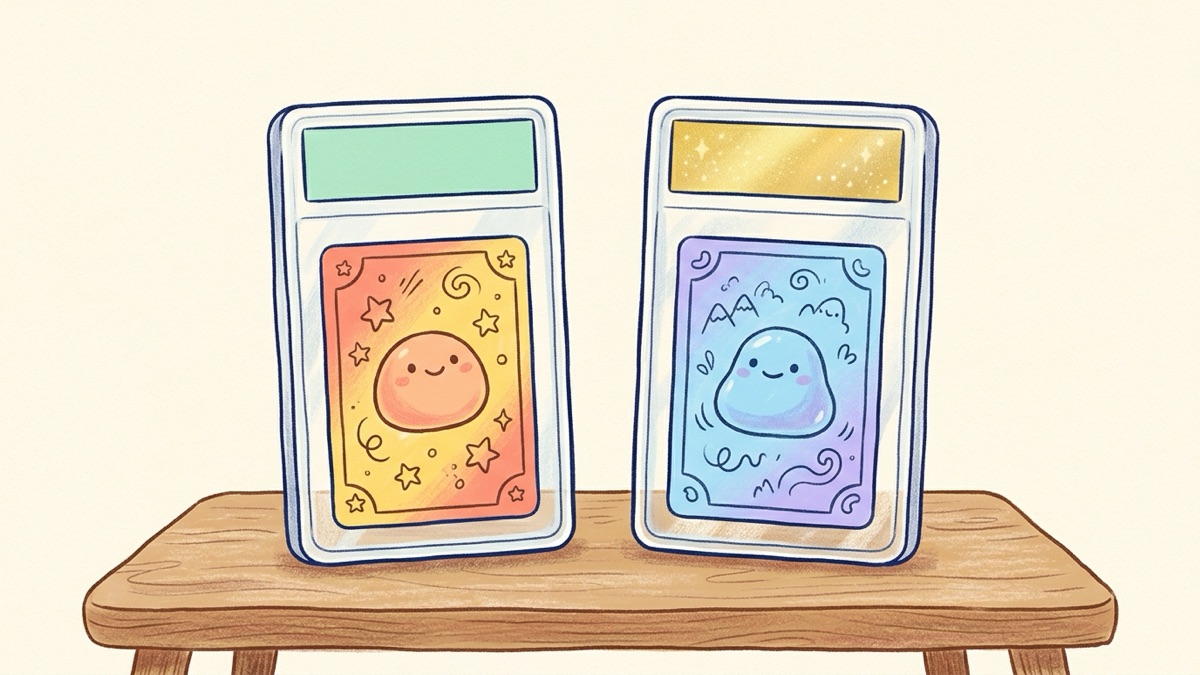
How strict is centering at PSA and CGC?
Centering is how evenly the picture sits inside its borders. Graders write it as a ratio: 55/45 means the wider border is 55 percent of the two opposite borders added together. For the full picture (pun fully intended), read our card centering guide.
On the front, both companies want about 55/45 or better for a regular 10, and 60/40 or better for a 9. On the back, both allow 75/25 for a 10 and 90/10 for a 9. The only real split is CGC's Pristine 10, which asks for 50/50.
That means centering alone rarely decides PSA vs CGC. What it does decide is whether a 10 is on the table at all. A card sitting at 58/42 on the front is out of 10 range at both companies, however crisp the corners are.
PSA also notes that its graders may allow a small variance for strong eye appeal, at their own discretion. Treat the limits as a firm guide rather than a laser line.
Try it
Snap a photo and measure your borders with the free card centering calculator. It runs in your browser and never uploads the photo.
How much does PSA cost compared with CGC?
As of September 2026, here is how the per-card prices line up on each company's official page.
PSA's lowest open tier is Standard at $59.99 for cards worth up to $1,000, because PSA's Value services are temporarily paused. Next come Priority at $79.99 (up to $1,500), Express at $199 (up to $2,500), Super Express at $349 (up to $5,000) and Premier at $599 (up to $10,000).
CGC starts lower. Bulk is $17 per card with a 25-card minimum and a $500 value cap, and Economy is $20 for cards up to $1,000. Standard is $55 (up to $3,000), Express is $100 (up to $10,000) and WalkThrough is $300 (up to $100,000). CGC Associate and Premium members save 10 percent, and Elite members save 20 percent.
CGC raised several prices in January 2026 (reported), so older posts you find online may show lower numbers. One sneaky cost applies at both companies: the value cap. If your card comes back worth more than its tier allows, the grader moves it up a tier and bills the difference.
Our PSA grading cost guide walks through every PSA tier and fee. To compare a whole submission, plug your card's value into the free grading cost calculator.
Which is faster, PSA or CGC?
Turnaround is where CGC shines right now. As of September 2026, at roughly the same price, CGC Standard ($55) estimates 10 business days while PSA Standard ($59.99) estimates 90 to 100 business days. That is the difference between a couple of weeks and roughly four months on the calendar.
Pay more and PSA speeds up: Express estimates 20 to 30 business days, Super Express 10 to 15 and Premier 7 to 10. CGC's top tiers are quicker still, with Express at 5 business days and WalkThrough at 2. The flip side is CGC's cheapest tiers, which are slow: Bulk estimates 150 business days and Economy 90.
Heads up
Every one of these numbers is an estimate, and both companies say so on their price pages. Busy seasons stretch them, so plan for the wait to run long rather than short.
What do PSA and CGC slabs look like?
A PSA slab is the one most people picture when they hear "graded card": a clear case with the classic red and white label. PSA seals it sonically, makes it tamper-evident, and prints the grade and a certification number on the label.
CGC's holders are ultrasonically welded, crystal clear, and designed to lock and stack together. The standard label is clean and simple, and a Pristine 10 gets the gold one. CGC labels carry microprinting, UV ink and holographic foil, plus a QR code on the back that links to the card's record on CGC's site.
Neither look is better by rule, and collectors will happily argue about it all night. If you want the slab buyers recognize fastest, that is PSA. If you love a tidy stack on a shelf, CGC's stacking holders are a nice touch.
Which sells for more, a PSA or a CGC slab?
For most Pokemon cards, the PSA slab is the benchmark. PSA graded 19.26 million of the 26.8 million cards the major companies handled in 2025, per Sports Illustrated, so more buyers know it, trust it and search for it by name. That bigger crowd is the main reason sellers reach for PSA when a card is valuable.
There is no fixed premium, though, and anyone who quotes one number for every card is guessing. The gap between a PSA 10 and a CGC 10 changes by card, by era and by month. CGC Pristine 10s are their own chase, and CGC's grading volume grew 121 percent in 2025 according to the same report, so its buyer pool is growing.
Tip
Before you choose, look up recent sold prices for your exact card as a PSA 10, a CGC Gem Mint 10 and a CGC Pristine 10. Sold prices, not asking prices. That five-minute check beats any rule of thumb.
Who should pick PSA, and who should pick CGC?
Pick PSA if:
- You plan to sell a valuable card and want the widest pool of buyers.
- You are building a set where most copies already live in PSA slabs and you want the shelf to match.
- You can wait, or you are paying for a faster tier anyway.
Pick CGC if:
- You want the card back sooner without paying for top-tier speed.
- You are grading a batch of cards to keep. As of September 2026, Bulk is $17 per card with a 25-card minimum.
- Your card is so well centered and clean that a Pristine 10 is a real possibility.
- You simply like the CGC look, gold Pristine label included.
Not sure the card deserves a slab at all? Start with is my card worth grading. Paying more to grade a card than it will ever sell for is a sad story with a very shiny ending.
What about Beckett, SGC and TAG?
PSA and CGC are the two biggest names for Pokemon, but three more graders come up in every "cgc vs psa vs beckett" thread:
- SGC is famous for its black "tuxedo" slabs and its long love affair with vintage sports cards. Its prices jumped in September 2026 (reported). Full matchup: SGC vs PSA.
- TAG grades with computer imaging and adds a precise score out of 1,000 plus a report that pictures each defect. Its regular tiers were paused as of September 2026. The full story: TAG grading explained.
- Beckett (BGS) is known for four sub-grades (centering, corners, edges and surface) and the rare Black Label, awarded when all four are 10. That is widely reported; Beckett's own site was offline when we checked. Head to head: PSA vs BGS.
One family note: Collectors, the company behind PSA, also owns SGC, and it announced a deal to buy Beckett in December 2025, saying Beckett will keep its own operations and standards. CGC is not part of that family.
What should you check before you choose?
Neither company can promise you a 10, and neither can we. What you can do is look before you pay: centering on both sides, four sharp corners, clean edges with no whitening, and a surface with no scratches or print lines under a bright light. If a card misses on any of those, which grader you pick matters much less than whether to grade it at all.
The MintGrade app, coming soon, will do this check from a single photo.
PSA vs CGC is less a fight than a fork in the road. Selling a big card? PSA's crowd is hard to beat. Keeping, batching or chasing Pristine? CGC makes a strong case, and it is quicker right now. Measure first, check sold prices second, and pick the slab that fits your plan.
MintGrade guides explain how grading works and help you decide what to submit. Only a grading company can assign a grade, and prices change daily, so check recent sold listings before you buy, sell or submit.
Questions collectors ask
Is PSA or CGC better for Pokemon cards?
Neither is better for every card. PSA is the most recognized slab and usually the safer pick for selling a valuable Pokemon card, while CGC is often faster for similar money and offers a Pristine 10 above its Gem Mint 10.
Is a CGC Pristine 10 better than a PSA 10?
On paper it is a stricter grade, because CGC Pristine 10 asks for 50/50 centering while a PSA 10 allows about 55/45 on the front. What buyers pay still depends on the card, so compare recent sold prices for both before you decide.
Is a CGC Gem Mint 10 the same as a PSA 10?
Their published centering limits match: about 55/45 on the front and 75/25 on the back. They are still different companies with different buyer pools, so the same card can sell for different prices in each slab.
Is CGC cheaper than PSA?
As of September 2026, yes at the low end. CGC Bulk is $17 per card with a 25-card minimum, while PSA's cheapest open tier is Standard at $59.99. At the standard level the prices are close: $55 at CGC and $59.99 at PSA.
Which is faster, PSA or CGC?
As of September 2026, CGC estimates 10 business days for its $55 Standard tier, while PSA estimates 90 to 100 business days for its $59.99 Standard tier. Both companies say turnaround times are estimates that can change.
Where these facts come from
- PSA grading standards: www.psacard.com/gradingstandards
- PSA trading card grading services and pricing: www.psacard.com/services/tradingcardgrading
- CGC Cards grading scale: www.cgccards.com/card-grading/grading-scale/
- CGC Cards grading services and fees: www.cgccards.com/submit/services-fees/cgc-grading/
- CGC Cards holders and labels: www.cgccards.com/card-grading/holder-label/
- CGC Cards help center: about CGC grades (sub-grades no longer offered): www.cgccards.com/about/help-center-faqs/cgc-cards-grading/about-cgc-grades/
- Sports Illustrated: over 26 million cards graded in 2025: www.si.com/collectibles/over-26-million-cards-graded-in-2025-how-the-market-expl
- Collectors announcement on acquiring Beckett (December 15, 2025): www.collectors.com/company-announcement
Read next

grading companies
SGC vs PSA: Which Grader Is Better for Your Cards?

grading companies
TAG Grading Explained: Scores, Cost and TAG vs PSA

grading costs
PSA Grading Cost in 2026: Every Tier and Hidden Fee