
Blog grading costs
Is My Card Worth Grading? A 5-Minute Check
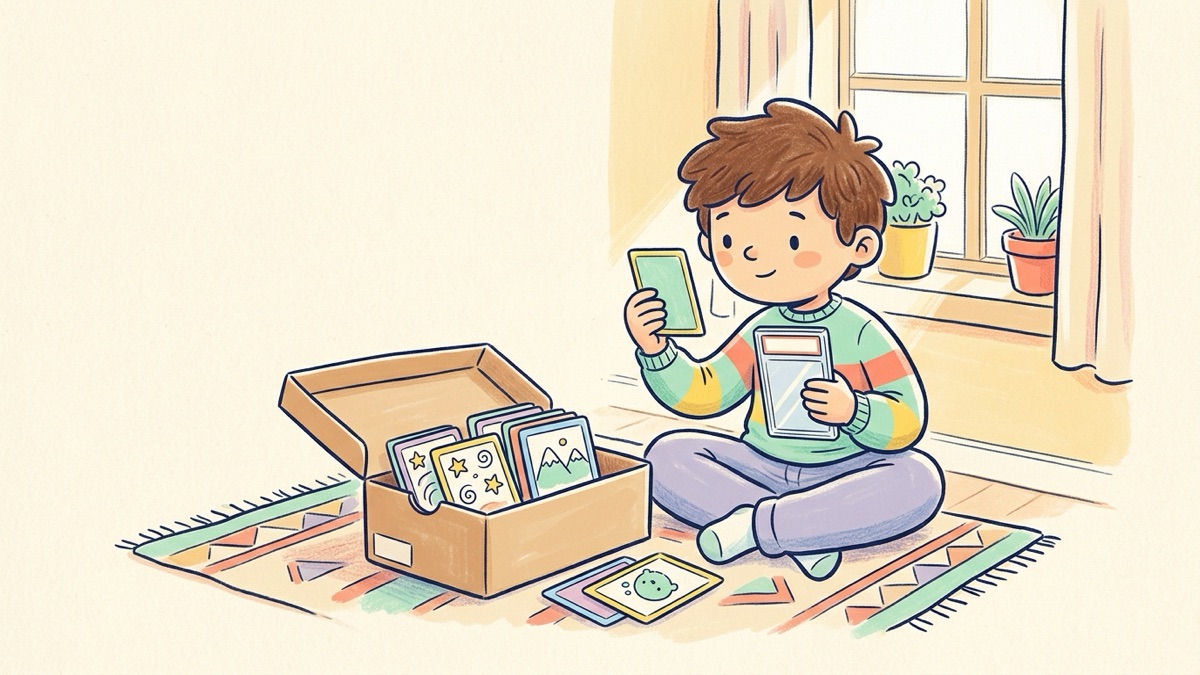
Maybe it's a shiny holo from last week's pack. Maybe it's a card that has lived in a shoebox since 1999. Either way, before you pay to grade it, you want to know one thing: is my card worth grading, or will I just end up with a nicer case and a thinner wallet?
Quick answer
Your card is worth grading if its graded sale price, after selling fees, minus grading and shipping costs, beats what it sells for raw after fees. Use sold prices, not asking prices. Judge your realistic grade (centering first), and only count the PSA 10 price if a 10 is truly realistic.
Key takeaways
- Look up sold prices for the raw card and for each grade you might get, from the same grading company.
- Be honest about the grade. Centering is the fastest filter: a PSA 10 needs about 55/45 or better on the front.
- As of September 2026, PSA's cheapest open tier is $59.99 per card before shipping, so low-value cards rarely pay off.
- The break-even rule: graded price after selling fees, minus grading and shipping, must beat the raw price after selling fees.
- Some cards are worth grading anyway, for authentication, protection or love. Just know that is not about profit.
Minute 1: What does your card sell for raw?
"Raw" means ungraded. Your job is to find what this exact card actually sold for recently, not what sellers are asking. Asking prices are wishes. Sold prices are facts.
On eBay, search the card and turn on the "Sold items" filter. Match everything: set, card number, language, edition and holo pattern. Match the condition too, because a Near Mint copy and a Lightly Played copy are different cards to a buyer. Take the middle of several recent sales, not the single best one.
Not sure your card is one of the valuable ones? Our guide to which Pokemon cards are worth money is a good first stop.
Minute 2: What does it sell for graded?
Now look up sold prices for the same card at a 10, a 9 and an 8, all from the same grading company. A PSA 9 and a CGC 9 are not the same price, so do not mix them.
Write the numbers down. On many popular cards you will see a big jump between a 9 and a 10, and sometimes an 8 sells for barely more than raw. That shape decides almost everything in minute 5.
Tip
If a grade has only one or two recent sales, treat the price with suspicion. One lucky auction is not a market.
Minute 3: What grade will your card realistically get?
No one can guarantee a grade, so plan around the grade you would bet on, not the one you hope for. Start with centering, because it is the easiest flaw to measure and it rules out a 10 faster than anything else. Here are PSA's centering guidelines from its grading standards page:
| PSA grade | Front centering | Back centering |
|---|---|---|
| PSA 10 | about 55/45 or better | 75/25 or better |
| PSA 9 | about 60/40 | 90/10 |
| PSA 8 | about 65/35 | 90/10 |
| PSA 7 | about 70/30 | 90/10 |
A ratio like 55/45 compares the border on one side to the other. Measure your card with the free card centering calculator, and read how graders measure centering if the numbers are new to you.
Then check the rest under a bright light: corners, edges and surface. Look for whitening (little white chips along the edges on the back), dents, scratches and print lines. Our Pokemon card condition guide shows what each flaw looks like.

Minute 4: What will grading cost, all in?
Add up everything between you and the slab, using prices as of September 2026:
- Grading fee. PSA's cheapest open tier is Standard at $59.99 per card, for cards worth up to $1,000 after grading. The full tier list is in our PSA grading cost guide.
- Shipping and insurance, both ways. This is per box, so it shrinks per card as you add cards. For our examples we use $45 per box, the starting placeholder in our calculator (not a real quote). In a box of 10, each card's share is $4.50.
- Selling fees. If you sell on eBay, the trading card categories charge 13.25 percent of the total sale up to $7,500, plus $0.40 per order over $10. That total includes shipping and sales tax the buyer pays, so real fees run a little higher than our simple math.
- Time. Standard is estimated at 90 to 100 business days. Here is how long PSA takes in real weeks.
So one card in a box of 10 at PSA Standard costs $59.99 plus $4.50, or $64.49, before it is sold.
Minute 5: Does it pass the break-even rule?
Here is the rule in one line:
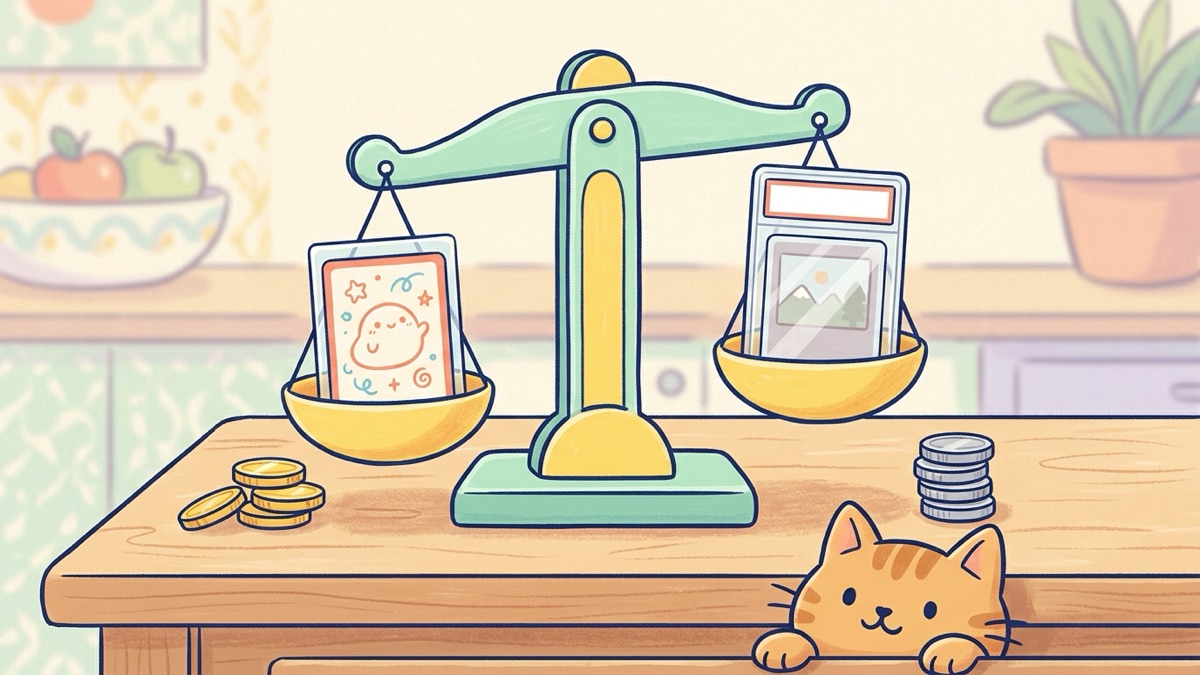
Graded price, minus selling fees, minus grading and shipping, must beat the raw price, minus selling fees.
There is a handy shortcut. Because the same 13.25 percent comes off both sides, the graded sale has to beat the raw sale by your all-in cost divided by 0.8675 (that is, 1 minus 0.1325). With the $64.49 from minute 4, that is $64.49 divided by 0.8675, or about $74.34. Round it to $75. If you send the card alone with the full $45 of shipping, the cost is $104.99 and the gap you need is about $121.
Try it
Skip the pencil. The grading cost calculator runs this math for you, and it lets you weight your chances of a 10, 9 or 8 instead of betting on one grade.
Two example cards, worked out
Both cards below are made up. The prices are round, hypothetical numbers chosen to show the math, not real sales. The fees are real, as of September 2026: PSA Standard at $59.99, a $4.50 shipping share and eBay's 13.25 percent plus $0.40.
Example 1: an off-center holo
Say an example card sells for $40 raw, $45 as a PSA 8, $90 as a PSA 9 and $300 as a PSA 10. You measure the front at 62/38.
- Realistic grade: 62/38 misses the 10 (about 55/45) and the 9 (about 60/40), so plan on an 8.
- Raw, after fees: 13.25 percent of $40 is $5.30, plus $0.40 is $5.70. You keep $40 minus $5.70, which is $34.30.
- PSA 8, after fees: 13.25 percent of $45 is $5.96, plus $0.40 is $6.36. You keep $38.64.
- Subtract the all-in cost: $38.64 minus $64.49 is minus $25.85.
- Compare: minus $25.85 against $34.30 raw. Grading loses $60.15.
Even a lucky 9 does not save it: $90 minus $12.33 in fees is $77.67, minus $64.49 is $13.18, still $21.12 behind selling raw. That shiny $300 PSA 10 price was never on the table for this copy. Sell it raw, or keep it in a sleeve and enjoy it.
Example 2: a sharp, well-centered card
Now say another example card sells for $150 raw, $120 as a PSA 8, $250 as a PSA 9 and $600 as a PSA 10. It measures 52/48 on the front and 70/30 on the back, and the corners and edges look clean under a lamp.
- Realistic grade: centering is inside the PSA 10 range, so plan on a 9 with a real shot at a 10.
- Raw, after fees: 13.25 percent of $150 is $19.88, plus $0.40 is $20.28. You keep $129.72.
- PSA 9, after fees: 13.25 percent of $250 is $33.13, plus $0.40 is $33.53. You keep $216.47, minus $64.49 is $151.98.
- Compare: $151.98 beats $129.72 by $22.26. The shortcut agrees: $250 minus $150 is $100, which clears the $75 bar.
- Tier check: even as a 10, $600 is under Standard's $1,000 max insured value, so no upcharge.
Here is the whole picture for Example 2, using the same made-up prices:
| Outcome | Sale price (made up) | You keep after all costs | Versus selling raw |
|---|---|---|---|
| Sell raw | $150 | $129.72 | no change |
| PSA 8 | $120 | $39.21 | minus $90.51 |
| PSA 9 | $250 | $151.98 | plus $22.26 |
| PSA 10 | $600 | $455.61 | plus $325.89 |
Verdict: worth grading if you are confident it is a 9 or better. But notice the risk. If a hidden flaw drops it to an 8, you are about $90 worse off than if you had just sold it raw.
When is a card worth grading anyway?
Money is not the only reason to grade. These are fair reasons, as long as you know you are paying for them:
- Keepsakes. A childhood favorite in a sealed, labeled slab is protected and easy to display. You are buying peace of mind, not profit.
- Authentication. Grading starts with a check that the card is genuine and not trimmed or recolored. For valuable vintage, like 1st Edition Pokemon cards, a slab can reassure a buyer more than any photo.
- A family heirloom. A card you plan to pass down gets a certification number that anyone can look up later, even long after you have forgotten which binder it lived in.
- Selling a pricey card. Many buyers of expensive cards prefer them graded, so a slab can make a high-value card easier to sell.
Heads up
A card that comes back "Authentic" (genuine, no number grade) or "Authentic Altered" (genuine but altered) is still charged the full grading fee. Qualifiers such as OC (off-center) also lower what a graded card sells for.
When should you skip grading?
Skip it when the numbers or the card say no:
- The graded 9 price barely beats the raw price.
- The card has a crease, obvious whitening or a dent you can see without a loupe.
- The centering is far outside the grade you need.
- It is a card you will never sell and are not worried about. A good sleeve and a rigid holder protect it for very little.
The 5-minute check, wrapped up
Sold prices, a realistic grade, the full cost, then the break-even rule. Five small steps save a lot of disappointment. The MintGrade app, coming soon, will do the centering and condition part of this check from a single photo.
MintGrade is made by Viral Labs and is not affiliated with any other app, price guide or grading company named here.
MintGrade guides explain how grading works and help you decide what to submit. Only a grading company can assign a grade, and prices change daily, so check recent sold listings before you buy, sell or submit.
Questions collectors ask
Should I grade my Pokemon cards?
Grade a card when its graded sale price, after selling fees and grading costs, beats what it sells for raw after fees, at the grade you realistically expect. A card worth a few dollars raw usually cannot clear that bar, while a clean, valuable card often can.
How much more does a graded card need to sell for to be worth it?
As of September 2026, with PSA Standard at $59.99, a $4.50 share of shipping and eBay's 13.25 percent trading card fee, the graded sale needs to beat the raw sale by about $75. Sent alone with $45 of shipping, it is about $121.
Is it worth grading a card that is off-center?
Usually not if you are hoping for a 10. PSA's standard for a 10 is about 55/45 or better on the front, so a card well outside that should be priced as a 9 or lower before you decide.
Is it worth grading a card just to prove it is real?
It can be. Grading includes an authentication step, and a slab with a certification number reassures buyers, which matters most for valuable vintage cards. Just know it is a cost, not a profit, if the grade will not lift the price.
Where these facts come from
- PSA trading card grading services and pricing: www.psacard.com/services/tradingcardgrading
- PSA grading standards: www.psacard.com/gradingstandards
- eBay selling fees (trading card final value fees): www.ebay.com/help/selling/fees-credits-invoices/selling-fees?id=4822
Read next
grading costs
PSA Grading Cost in 2026: Every Tier and Hidden Fee
grading costs
How Long Does PSA Take to Grade Cards in 2026?