
Blog care and storage
How to Store Pokemon Cards So They Stay Mint
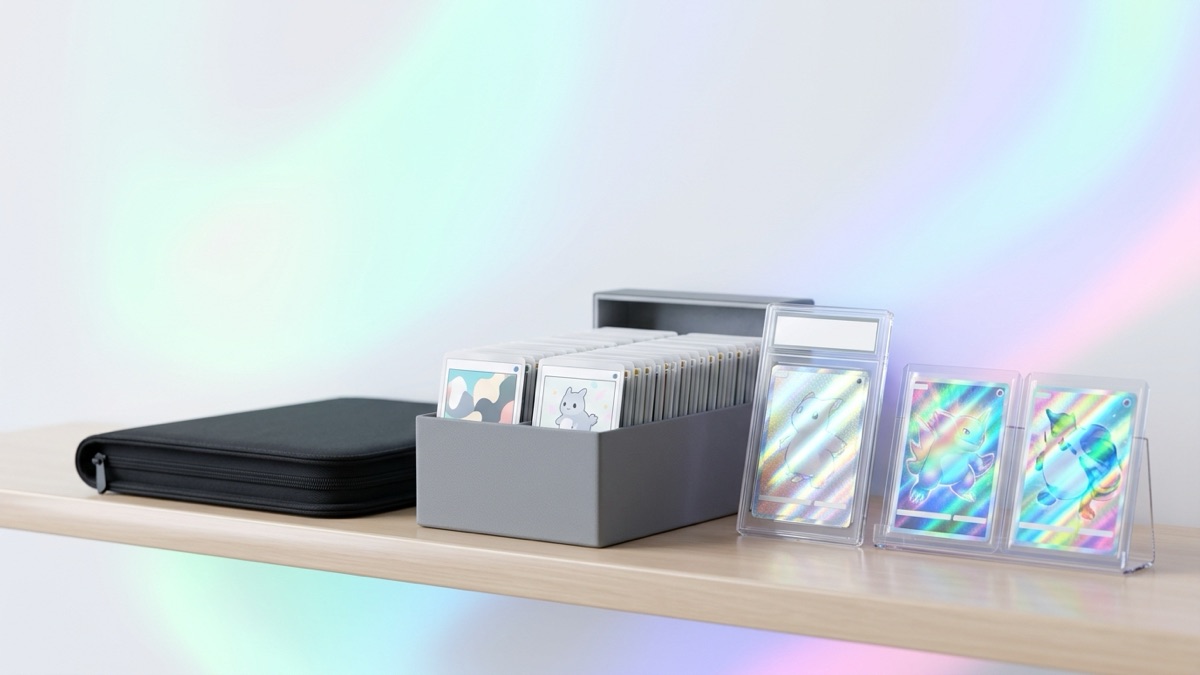
You pulled something great, and now it is sitting on your desk, naked, one spilled drink away from disaster. Or maybe you have a shoebox of childhood cards and a sinking feeling about the attic. Either way, good storage is cheap, simple and the only thing that keeps a card looking the way it did the day it came out of the pack.
Quick answer
To store Pokemon cards, sleeve every good card in a clear, acid-free polypropylene penny sleeve. Put valuable cards in a toploader or semi-rigid card saver, keep collections in a side-loading binder without rings through the pages, and store everything upright in a cool, dry, dark room. Avoid attics, basements, sunlight and rubber bands.
Key takeaways
- A penny sleeve is the first layer for any card you care about. Look for clear polypropylene that says acid-free and PVC-free.
- Rigid toploaders are best for storage and display. PSA wants semi-rigid card savers for grading, not toploaders.
- Good binders have side-loading pockets and no round rings pressing into the pages.
- Archivists say keep paper below 75 degrees Fahrenheit and below 65 percent humidity, out of light, and out of attics, basements and garages.
- Never use rubber bands, tape or PVC pages directly on cards you want to keep mint.
What are you protecting your cards from?
A Pokemon card is printed card stock, so it has the same enemies as any paper: scratches, bends, damp, heat and light. Most damage comes from ordinary life, not disasters. A card slides across a table and picks up a scratch across the holo. A stack gets knocked over and a corner folds. A box sits in a humid garage for a summer and the cards start to ripple.
Graders look at centering, corners, edges and surface. You cannot change centering, but corners, edges and surface are exactly what storage protects. A soft corner or a scuffed holo can be the difference between grades, and our pokemon card condition guide shows how fast small flaws add up when you sell.
So think of storage as layers. Each one stops a different kind of damage.
Which storage supplies do you actually need?
Here is the whole toolkit in one place. You do not need all of it for every card.
| Supply | What it stops | Best for | Skip it for |
|---|---|---|---|
| Penny sleeve | Scratches, dust, fingerprints | Every card worth keeping | Pure bulk commons |
| Toploader | Bends, knocks | Valuable cards, display, shipping a sale | Grading submissions |
| Card saver (semi-rigid) | Bends in transit | Grading submissions, compact storage | Display |
| Side-loading binder | Scuffs, spills, lost cards | Sets and collections you flip through | Your very best cards |
| Card storage box | Crushing, light, dust | Bulk cards and sleeved cards in rows | Loose, unsleeved holos |
The rule of thumb: the more a card is worth, the more layers it gets. A common goes in a box. A nice holo gets a sleeve and a binder pocket. A chase card gets a sleeve and a rigid holder, and maybe a trip to a grader.
How do penny sleeves protect cards?
A penny sleeve is a thin, clear, soft plastic sleeve that fits one standard card. It is named for how cheap it is, and it is the single best thing you can do for a card. It keeps fingers, dust and grit off the surface, and it lets the card slide in and out of harder holders without scraping.
Material matters. Ultra PRO describes its Penny Sleeves as non-PVC, acid-free, archival-safe polypropylene for standard 2.5 by 3.5 inch cards. That lines up with archivists: the US National Archives recommends stable plastics such as polyester, polypropylene or polyethylene for storing paper and advises against PVC.
Slide the card in short edge first, keeping it flat and square, so a corner never catches on the sleeve's opening. Our guide to penny sleeves covers perfect fit sleeves, double sleeving and how to sleeve without dinging a corner.
Toploaders or card savers: which rigid holder?
Once a card is sleeved, a rigid holder stops it from bending. There are two main types, and they have different jobs.
Toploaders are stiff, clear holders, open on one short side. BCW's standard toploader is rigid PVC with 12 mil panels, measures 3 by 4 1/16 inches outside and fits cards up to 35pt thick. They are the go-to for storing and displaying a valuable card, or for mailing a single card you sold.
Card savers are semi-rigid holders: thinner, a bit flexible and taller than a toploader. PSA's shipping guide asks for each card in a clear penny sleeve inside a semi-rigid holder of 3 5/16 by 4 7/8 inches, and says not to use toploaders, tape, pull tabs or sticky notes. They also stack flat and take up less room.
Wait, PVC? Yes: most toploaders and many semi-rigid holders are rigid PVC, and BCW describes its semi-rigid holder as archival-safe PVC with no plasticizers or stearates. That is one more reason the penny sleeve goes on first, so the card itself only touches polypropylene. Whichever you use, sleeve the card before it goes in. Our card savers vs toploaders guide compares them side by side and walks through packing for a grader.
Heads up
Never tape a toploader shut. Tape can peel, leave sticky residue and grab the sleeve or card when someone opens it later. If a card keeps sliding out, use a snugger sleeve or a card saver instead.
Are binders safe for Pokemon cards?
Yes, if you choose well. A good binder is one of the nicest ways to enjoy a collection, and a bad one is a slow-motion dent machine. Look for four things:
- Side-loading pockets. The card goes in from the side, so it cannot slide out of the top when you turn the page.
- No round O-rings through the pages. In an overfilled ring binder, pages can slip over the rings and get pressed against the metal when you close it. Collectors call the result binder dents. Bound pages, or D-rings that let pages lie flat, avoid it.
- Acid-free, PVC-free pages. Polypropylene is the usual choice. Skip old soft vinyl pages.
- A closure. A zip or a strap keeps the binder shut, so cards do not spill if it tips over.
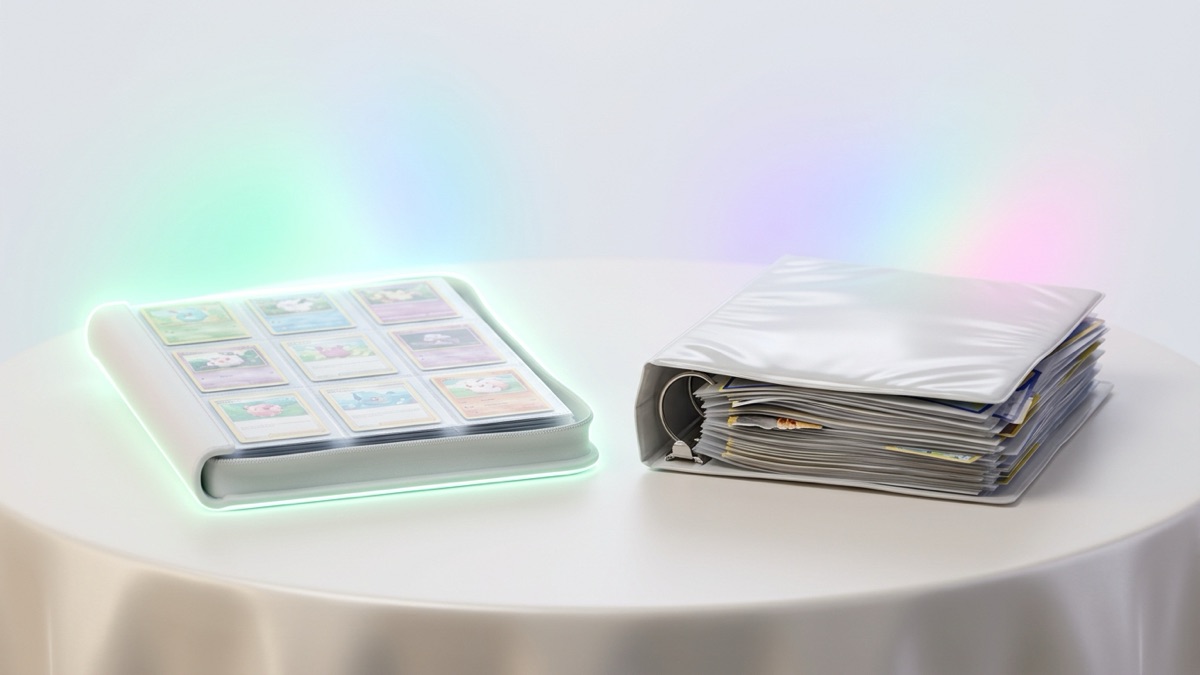
Put one card per pocket, facing out, and do not stuff two cards back to back in a single pocket. Our guide to the best Pokemon binders explains pocket sizes, rings and what to look for on the label.
How should you store bulk cards and graded slabs?
Bulk cards (the commons and uncommons from every pack) live happily in cardboard storage boxes made for trading cards. Stand them upright in rows, like books on a shelf. Fill the row so the cards do not flop over, but do not cram them in so tight you have to wedge the last one down. Use cardboard dividers to keep sets apart.
Two bulk habits to drop. First, rubber bands straight around a stack of cards can dent the edges of the top and bottom cards. When PSA and CGC use rubber bands, they go around cardboard pieces sandwiching the cards, and CGC warns that packing too tightly can damage cards. Second, loose holos stacked face to face rub against each other. Sleeve anything shiny that you care about.
Graded slabs are already sealed, but the plastic case can still scratch, and a scratched case looks worse in photos when you sell. Store slabs upright in a box made for graded cards, or in slab sleeves, so they do not rub against each other. The same heat, light and damp rules below still apply.
What temperature and humidity are safe for Pokemon cards?
Nobody publishes an official climate chart for Pokemon cards, but they are paper, and archivists have spent a long time working out what paper likes.
| Condition | What archivists recommend | What it means for cards |
|---|---|---|
| Temperature | Below 75 degrees Fahrenheit (National Archives); room temperature or cooler (Library of Congress) | Keep cards in a room you would be comfortable in |
| Humidity, upper limit | Below 65 percent to prevent mold (National Archives) | Damp rooms risk mold, rippling and curling |
| Humidity, lower limit | Below 15 percent can make paper brittle (National Archives) | Very dry is not good either |
| Target for paper | About 35 percent (Library of Congress) | Dry, steady air is the goal |
| Stability | A clean, stable environment (Library of Congress) | Big daily swings stress card stock |
The Canadian Conservation Institute puts it plainly: at 60 percent relative humidity, visible mold is "just possible on some surfaces", and above 75 percent counts as damp. Muggy weather is also when collectors tend to notice cards rippling or curling.
If you live somewhere humid, a small digital hygrometer (a humidity meter) tells you what your storage spot is really like. A dehumidifier helps in a damp room. Some collectors add silica gel packs to a closed box, but those stop working once they are full, so they need drying out or replacing.
Tip
A closet in a room you actually live in is usually the sweet spot. Heating and cooling keep it steady, it is dark, and it is far from the kitchen and bathroom steam.
Does sunlight fade Pokemon cards?
Yes. The National Archives says exposure to all light, visible and ultraviolet, can cause fading and darkening, and that daylight and fluorescent light are the most damaging because they carry more ultraviolet. The Library of Congress recommends minimal exposure to any light and none that is direct or intense.
That does not mean you can never display a card. It means no windowsills, no sunny shelves and no spotlights. Put display cards on an inside wall, out of direct sun, and rotate them now and then so the same card is not on show for years. Archivists display copies and keep originals in a box, and for a card worth real money, that thinking still applies.
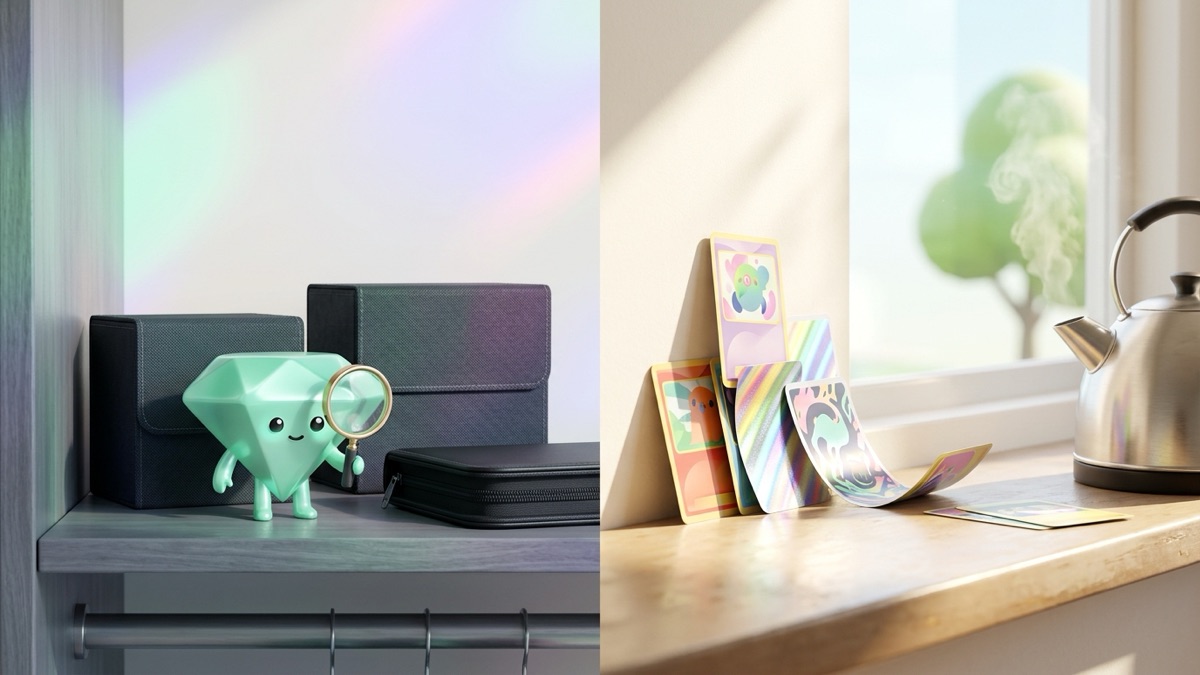
Where should you never keep Pokemon cards?
Both the National Archives and the Library of Congress say to keep paper out of the same places:
- Attics. Hot in summer, cold in winter, and the swings are brutal.
- Basements. Often damp, and the first place a leak or flood reaches.
- Garages and sheds. No climate control at all.
- Cars. A closed car in the sun gets far hotter than any room.
- Near kitchens and bathrooms. Steam and spills.
- On the floor. Spills, pets, vacuums and small feet.
What should you never do to your cards?
A quick list of habits that quietly ruin cards:
- Handling with dirty or lotioned hands. The National Archives says to wash your hands before handling paper and skip lotion, which can stain it. Also: no eating or drinking over your cards.
- Using rubber bands, paper clips or tape directly on cards or sleeves.
- Storing in old PVC pages or cheap sleeves with no material listed.
- Forcing a card into a sleeve, toploader or pocket that is too tight.
- Writing on a sleeve or holder with the card inside. The pen pressure can dent the card.
- Stacking unsleeved holos face to face or leaving them loose in a box.
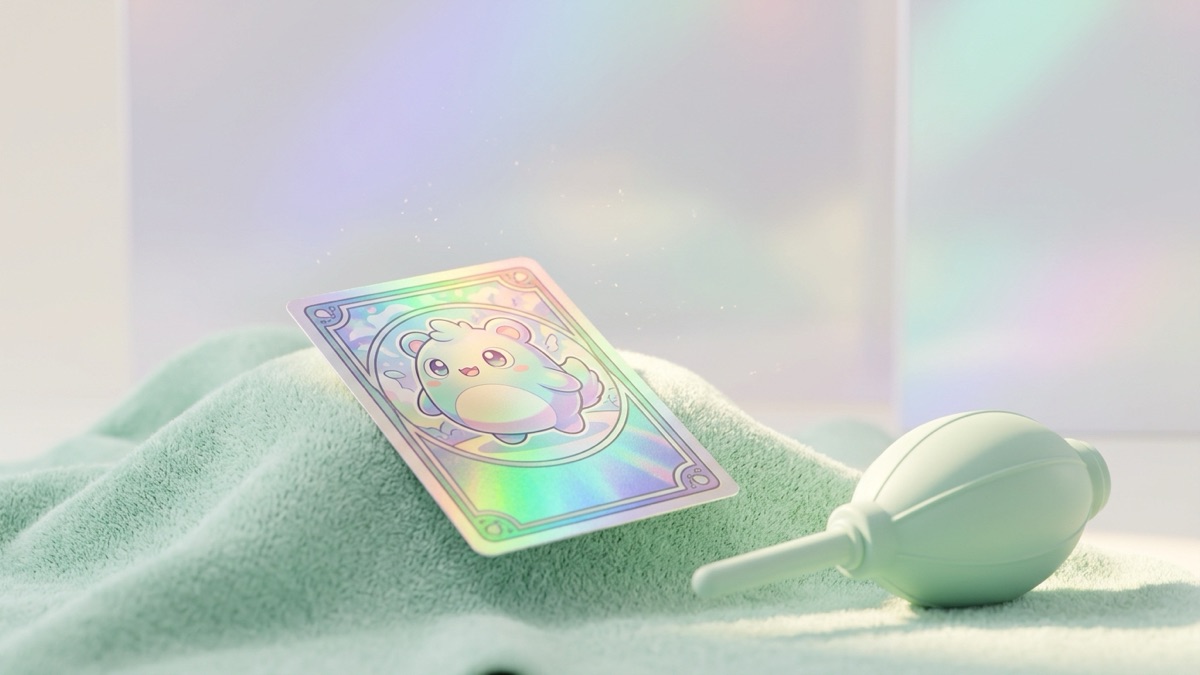
- Cleaning cards with water or chemicals. Our guide to how to clean Pokemon cards covers what is safe and what is not.
Which cards deserve the premium treatment?
Not every card needs a toploader and a spot on the good shelf. The ones that do are the cards that are already valuable, or that might be worth grading. Centering is the first check, because no amount of good storage fixes a card printed off center.
Try it
Before you tuck a big pull away, snap a straight photo and run it through the free card centering calculator. If the front measures near 55/45 or better, it may be a grading candidate, and it deserves a sleeve and a rigid holder right away.
The MintGrade app walks you through the same checks: measure the centering on your own photo, check the corners, edges and surface under a lamp, and see whether grading pays off.
The takeaway
Great storage is not fancy. Sleeve anything you care about in clear, PVC-free polypropylene, give the best cards a rigid holder, pick a side-loading binder without rings pressing into pages, and keep it all somewhere cool, dry, dark and boring. Do that, and the card you pulled today should look the same years from now.
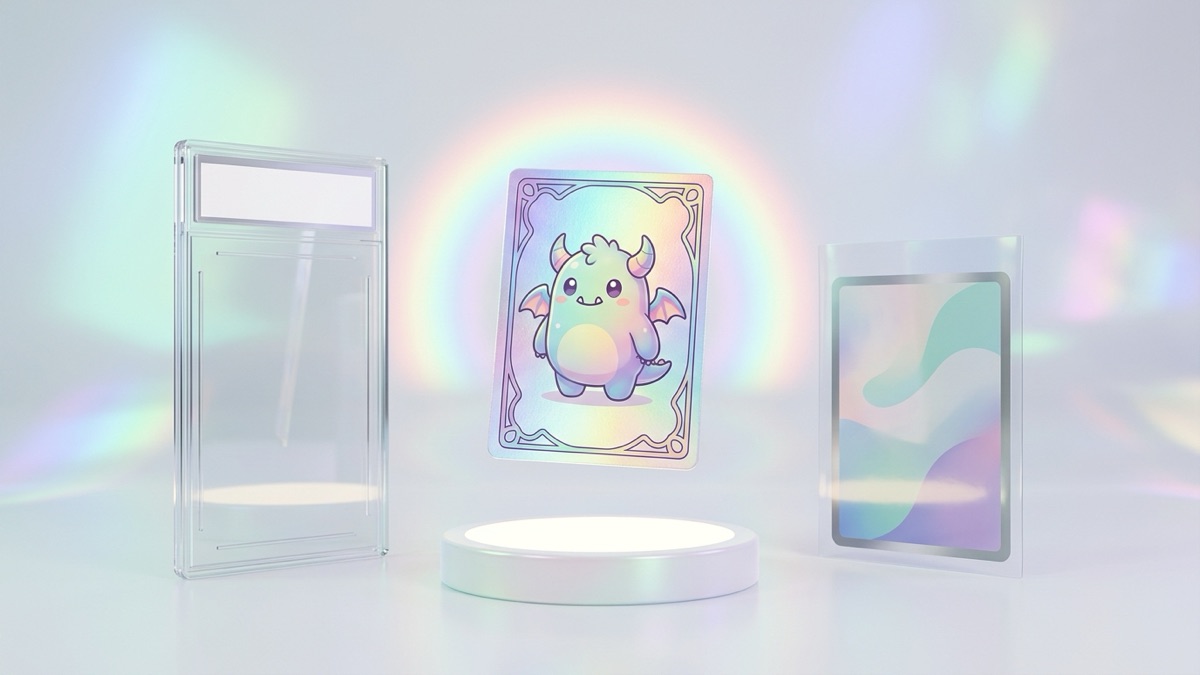
The pictures in this guide are AI-generated illustrations of what to look for, not photos of real graded cards. Any fee or price in it carries the month it was checked against the grading company's own page or recent sold listings (sources below). MintGrade guides explain how grading works and help you decide what to submit. Only a grading company can assign a grade, and prices change daily, so check recent sold listings before you buy, sell or submit.
Questions collectors ask
What is the best way to store Pokemon cards?
Put every card worth keeping in a clear penny sleeve. Move your best cards into a toploader or a semi-rigid card saver, keep collections in a side-loading binder with no rings through the pages, and store everything in a cool, dry, dark room.
Is it bad to keep Pokemon cards in a binder?
No, as long as it is the right binder. Look for side-loading pockets, pages made of acid-free polypropylene rather than PVC, and bound pages or D-rings instead of round O-rings, which can dent cards near the spine.
What humidity should Pokemon cards be stored at?
The US National Archives recommends keeping paper below 65 percent relative humidity to prevent mold and warns that below 15 percent paper can turn brittle. The Library of Congress aims for about 35 percent in its paper storage.
Can sunlight damage Pokemon cards?
Yes. The National Archives says all light, visible and ultraviolet, can cause fading, and that daylight and fluorescent light are the most damaging. Keep cards out of windows and display your favorites away from direct sun.
Should I store Pokemon cards in the attic or basement?
No. Both the National Archives and the Library of Congress tell people to keep paper out of attics, damp basements and garages, where heat, damp and big swings do the most harm. A closet in a room you live in is a better bet.
Where these facts come from
- National Archives: Storing family papers and photographs: www.archives.gov/preservation/family-archives/storing
- National Archives: Displaying family papers and photographs: www.archives.gov/preservation/family-archives/displaying.html
- National Archives: Handling family papers and photographs: www.archives.gov/preservation/family-archives/handling.html
- Library of Congress: Care, handling and storage of works on paper: www.loc.gov/preservation/care/paper.html
- Canadian Conservation Institute: Agent of deterioration, incorrect relative humidity: www.canada.ca/en/conservation-institute/services/agents-deterioration/humidity.h
- Missouri State Archives: Plastics for storing paper records: www.sos.mo.gov/archives/localrecs/conservation/notes/plastics
- Ultra PRO: PENNY SLEEVES soft trading card protectors: ultrapro.com/products/100ct-penny-sleeves-2-5-x-3-5-soft-trading-card-protectors
- BCW: 3x4 Topload Card Holder, Standard: www.bcwsupplies.com/3x4-topload-card-holder
- BCW: Semi-Rigid Card Holder #1: www.bcwsupplies.com/semi-rigid-card-holder-no1
- PSA shipping guide: how to package: www.psacard.com/info/shipguide
- Elite Fourum: collector discussion of binder dents: www.elitefourum.com/t/binder-dents/28647
Read next
care and storage
How to Clean Pokemon Cards Safely (and What to Avoid)
grading companies
PSA vs CGC for Pokemon Cards: Which Should You Pick?
grading costs
PSA Grading Cost in 2026: Every Tier and Hidden Fee
grading basics
PSA 10 Requirements: The Gem Mint Checklist
grading costs
PSA Minimum Grade: What It Is and When to Use It