
PSA 10 Requirements: The Gem Mint Checklist
You pulled a beauty. The holo glows, the corners look crisp, and a little voice says "that's a 10." Before you pay to find out, it helps to know exactly what PSA means by Gem Mint, because the bar is higher, and far more specific, than "looks great."
Quick answer
A PSA 10 (Gem Mint) must be a virtually perfect card: four perfectly sharp corners, sharp focus, full original gloss and no staining of any kind. Centering must be within about 55/45 on the front and 75/25 on the back. PSA may forgive one slight printing imperfection if it does not hurt the card's overall appeal.
Key takeaways
- PSA's whole definition of a 10 fits in one short paragraph: sharp corners, sharp focus, full gloss, no stains and tight centering.
- The front needs about 55/45 centering or better and the back needs 75/25 or better. Your worst direction is the one that counts.
- A slight printing imperfection is the only flaw PSA says it may allow in a 10, and only if the card still looks great.
- There is no 9.5 at PSA, so a card that misses Gem Mint by a hair comes back a 9 or lower.
- Nobody can promise a 10, but a careful pre-check tells you whether one is even possible.
What does PSA require for a PSA 10?
PSA's grading standards call a Gem Mint 10 "a virtually perfect card." In plain words, it needs four perfectly sharp corners, sharp focus and full original gloss. It must be free of staining of any kind. And the picture has to sit within about 55/45 centering on the front and 75/25 on the back.
There is one small mercy. PSA says it may allow a slight printing imperfection, as long as it does not hurt the card's overall appeal. That is the only flaw the 10 description forgives.
Notice the word "virtually." A PSA 10 is not flawless under a microscope; it is a card where a trained grader finds nothing that takes away from it. Graders look at four areas to decide that: centering, corners, edges and surface. PSA's Grader Notes, which come with Express orders and higher, break a grade down into exactly those four categories.
| Check | What a PSA 10 needs | What usually stops it |
|---|---|---|
| Centering | About 55/45 front, 75/25 back | One border visibly wider than the one opposite |
| Corners | Four perfectly sharp corners | A white fleck or a soft tip on a single corner |
| Edges | Clean, even edges with no wear | Whitening or tiny nicks along the back edges |
| Surface | Sharp focus, full gloss, no stains | Holo scratches, dents, scuffs or a stain |
How much centering do you need for a PSA 10?
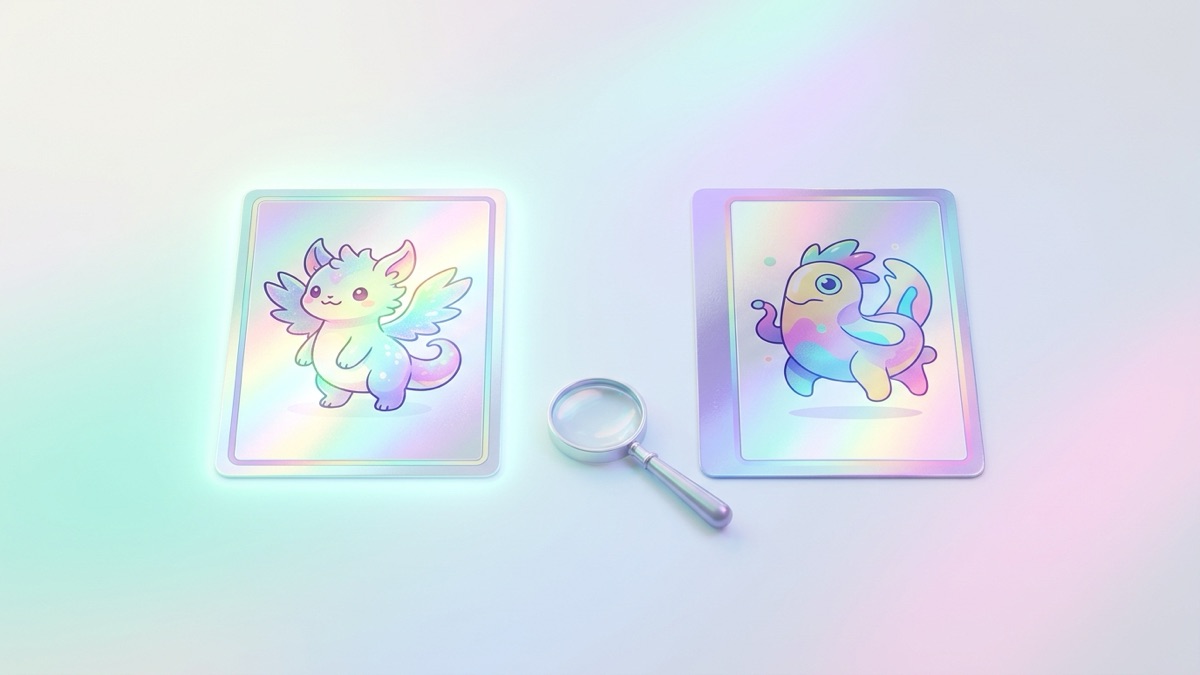
Centering compares the border widths on opposite sides of the card. At 55/45, the wider border takes 55 percent of the two borders combined and the thinner one takes 45. PSA checks left to right and top to bottom, front and back, and goes by the most off-center part of the card.
How tight is that? If the left and right borders add up to 4 mm, 55/45 means 2.2 mm on one side and 1.8 mm on the other. That is a difference of 0.4 mm, less than the thickness of a credit card. Your eyes will not catch it reliably. A measurement will.
The back is stricter than people expect, too. A PSA 9 allows 90/10 on the back, but a 10 needs 75/25. So a card with a gorgeous front and a badly shifted back can top out at 9.
Two footnotes. Hobby sites reported that PSA tightened the front limit for a 10 to about 55/45 in 2025 (it was long quoted as 60/40), so older guides may show the looser number. And PSA's notes describe some flexibility: a small variance at the grader's discretion when eye appeal is strong, and a 5 percent front centering leeway for cards grading 7 or better. PSA's own example of that leeway is a 65/35 card that still earns a 9, not a 10. Do not plan a Gem Mint around it.
Try it
Drop a straight photo of the front and back into the free card centering calculator. It shows your ratios against the PSA 10 and PSA 9 limits in seconds, and your photo never leaves your browser. New to the numbers? Our guide to how graders measure centering walks through it.
What do "perfectly sharp corners" look like?
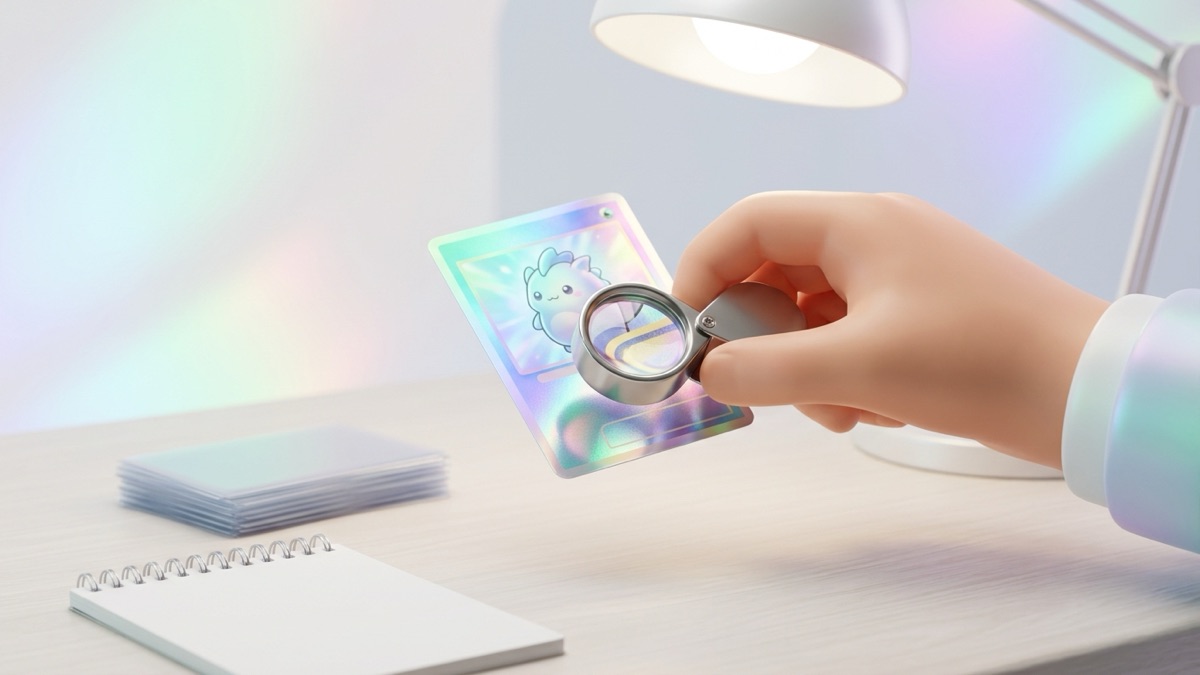
Look at each corner through a 10x loupe, a small magnifier. A Gem Mint corner comes to a clean point: no white showing through the ink, no fuzz, no bend, no flattened tip.
Check all eight corners: four on the front and four on the back. On Pokemon cards, the dark blue back makes any white fleck easy to spot, so start there.
Here is a detail worth knowing. Corner wear does not even appear in PSA's list of flaws allowed at a 9. The first grade that mentions it is the PSA 8, which allows the slightest fraying at one or two corners. So a corner that shows wear under the loupe is a warning sign for more than just the 10.
Do edges matter for a PSA 10?
Yes, even though PSA's 10 paragraph does not name them. Lower grades do: PSA's description of a 6 mentions very slight notching on the edges, and a 5 allows minor chipping. A virtually perfect card has none of that.
On Pokemon cards, the usual culprit is whitening: tiny white specks along the edge where the blue ink on the back has chipped away. Hold the card back side up under a bright lamp and run your eye slowly along all four edges. Then do the front, where silver and yellow borders can hide small nicks.
What counts as "surface" for a PSA 10?
Three phrases from PSA's definition cover the surface:
- Sharp focus. The printed picture is crisp and in register, meaning the color layers line up. A blurry or doubled print can earn the OF (out of focus) qualifier instead of a clean grade.
- Full original gloss. No dull patches, scuffs or scratches, and no dents you can feel. Holo foil shows every hairline scratch, so tilt the card under a single light.
- Free of staining of any kind. Not "a little," not "only on the back." A very slight wax stain on the back is one of the flaws PSA lists for a 9, which tells you it has no place on a 10.
Then there is the allowance. PSA may accept a slight printing imperfection on a 10, such as a tiny print dot, if the card's appeal does not suffer. A PSA 9 is allowed "a minor printing imperfection." Where "slight" ends and "minor" begins is the grader's call, so treat any print flaw you can see without a loupe as a likely 9.
Heads up
Do not clean, polish, press or touch up a card to chase a 10. PSA lists cleaning solutions, surface sprays, crease pressing, scratch removal and recoloring as alterations. An altered card does not get a number at all. Our guide to PSA Authentic Altered explains what happens instead.
Why is a PSA 10 so hard to get?
Because a 10 asks for everything at once. A card that is perfect in three areas and has one minor flaw in the fourth is a 9 at best, and sometimes lower. PSA describes a 9 as "superb" with only one minor flaw: a slight wax stain on the back, a minor printing imperfection or slightly off-white borders.
A few other things stack the odds:
- No 9.5. PSA's half grades run from 2 to 9 only. There is no in-between reward for a near miss.
- Factory flaws. Cards can come out of the pack already off-center, with print lines or with rough edges. Fresh from the pack is not the same as Gem Mint.
- Judgment on the line. PSA's standards say most grading is objective, but on borderline cards graders weigh eye appeal and what the market will accept. A card that measures right on a limit can go either way.
Gem rate, the share of submitted copies that come back a 10, varies a lot from card to card, and the pop report shows how many 10s exist. That rarity is exactly why buyers chase them.
Fun fact
PSA's FAQ says Grader Notes are not included for cards that get a 10. Which makes sense: there is nothing to point out.
Your PSA 10 pre-check list
Print this or keep it on your phone. Work through it under a bright lamp with a 10x loupe, card out of its toploader, and answer honestly.
- Front centering. Measure left to right and top to bottom. Is the worst direction about 55/45 or better?
- Back centering. Is the worst direction 75/25 or better?
- Corners. Are all eight corners sharp to a point under the loupe, with no white showing?
- Edges. Are all four edges, front and back, free of whitening, nicks and chips?
- Front surface. Tilting the card under one light, do you see zero scratches, scuffs, dents or dull spots?
- Back surface. Same check, including faint wax marks, water spots or other stains.
- Focus and print. Is the picture crisp with colors lined up, and is there at most one tiny print flaw you need a loupe to find?
- Untouched. Has the card never been cleaned, wiped with anything wet, pressed or marked?
- Arm's length. Does it still look perfect when you hold it at arm's length and just enjoy it?
If every answer is yes, a 10 is possible. Possible, not promised: only the grader decides. If even one answer is no, plan for a 9 or lower and do the money math for that result before you pay. Our step-by-step guide to how to grade Pokemon cards covers the rest of the process, from picking a tier to packing the box.
What happens if your card misses a 10?
Plenty of cards do, and that is fine. A card with one minor flaw lands at a 9, which is sometimes a great result and sometimes a money loser. Our comparison of PSA 9 vs PSA 10 shows how to tell which situation you are in.
There is also a third outcome. A card that meets every standard for its grade except one can come back with a qualifier, such as OC for off center, printed next to the number. Our guide to PSA qualifiers explains each code and what it does to value. For the full ladder of grades from 1 to 10, see the PSA grading scale.
The MintGrade app walks you through the same checks: measure the centering on your own photo, check the corners, edges and surface under a lamp, and see whether grading pays off.
The takeaway
A PSA 10 is not magic, it is a checklist. Tight centering front and back, eight sharp corners, clean edges and a surface with full gloss and no stains, with room for one tiny print flaw at most. Run the list honestly and spend your grading money on the cards with a real shot at Gem Mint.
The pictures in this guide are AI-generated illustrations of what to look for, not photos of real graded cards. Any fee or price in it carries the month it was checked against the grading company's own page or recent sold listings (sources below). MintGrade guides explain how grading works and help you decide what to submit. Only a grading company can assign a grade, and prices change daily, so check recent sold listings before you buy, sell or submit.
Questions collectors ask
How do you get a PSA 10?
You get a PSA 10 by submitting a card that is virtually perfect. Check it under a bright lamp with a 10x loupe first: about 55/45 or better centering on the front and 75/25 on the back, sharp corners, clean edges and a surface with no scratches or stains. If it passes all of that, a 10 is possible, but only the grader decides.
What are the requirements for a PSA 10?
PSA describes a Gem Mint 10 as a virtually perfect card: four perfectly sharp corners, sharp focus, full original gloss and no staining of any kind, with centering of about 55/45 or better on the front and 75/25 or better on the back.
What centering do you need for a PSA 10?
About 55/45 or better on the front and 75/25 or better on the back. PSA measures left to right and top to bottom and goes by the most off-center part of the card, so your worst direction decides it.
Can a PSA 10 have any flaws at all?
One kind. PSA says it may allow a slight printing imperfection if it does not hurt the card's overall appeal. Worn corners, whitening on the edges, scratches or stains will keep a card out of a 10.
Is there a PSA 9.5?
No. PSA gives half grades only between 2 and 9, so a card that just misses a 10 comes back a 9 or lower.
How can I improve my chances of getting a PSA 10?
Sleeve cards straight from the pack, handle them by the edges, and check centering, corners, edges and surface before you submit. Never clean, press or touch up a card, because PSA treats that as an alteration.
Where these facts come from
- PSA grading standards (grade definitions, qualifiers, eye appeal and centering notes): www.psacard.com/gradingstandards
- PSA FAQ (Grader Notes categories, qualifiers and no grades): www.psacard.com/support/faq
- PSA trading card grading services (Grader Notes at Express and higher): www.psacard.com/services/tradingcardgrading
Read next
grading basics
How to Grade Pokemon Cards: A Step-by-Step Guide
grading basics
What Is a PSA 10? The PSA Grading Scale Explained
grading basics
PSA 9 vs PSA 10: Why One Point Changes the Price

grading companies
PSA vs CGC for Pokemon Cards: Which Should You Pick?
grading costs
Is My Card Worth Grading? A 5-Minute Check