
PSA 9 vs PSA 10: Why One Point Changes the Price
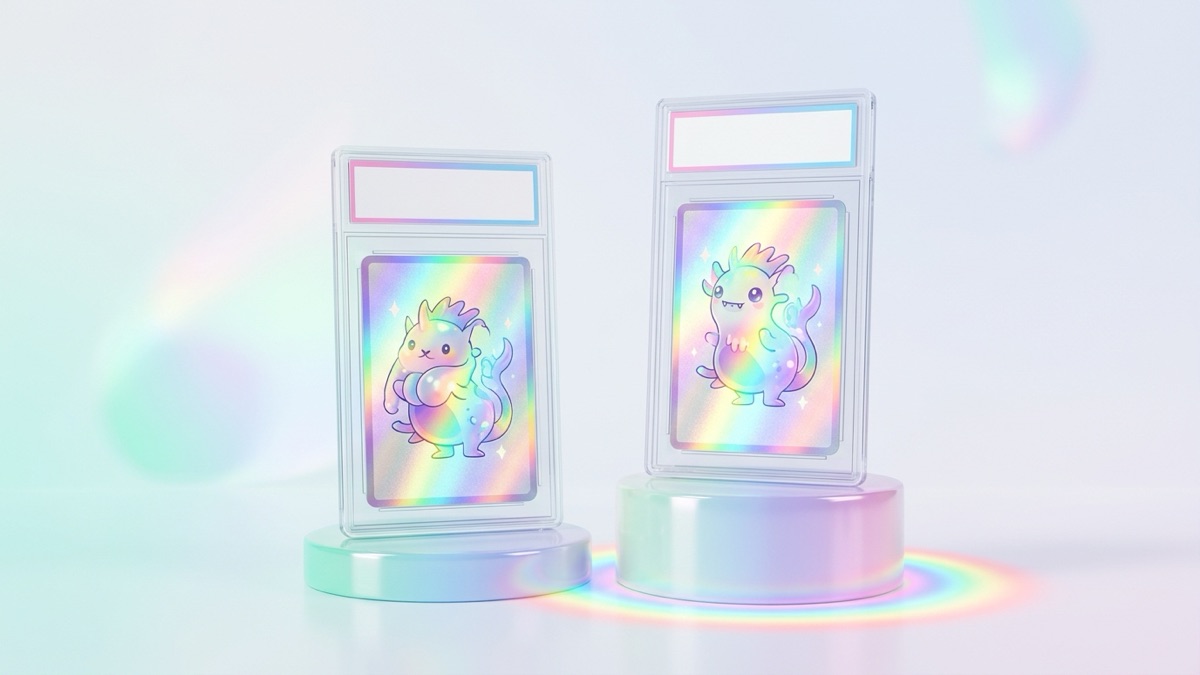
Your card came back a PSA 9. A friend's copy of the same card came back a 10. In the slabs they look like twins, yet one sells for a lot more than the other. What is going on? One grade point, and a very specific gap in what PSA allows.
Quick answer
A PSA 10 (Gem Mint) must be virtually perfect, with about 55/45 front and 75/25 back centering. A PSA 9 (Mint) allows one minor flaw, such as a small print imperfection or slightly off-white borders, and about 60/40 front and 90/10 back. The price gap varies by card and is often large, so check sold prices for both.
Key takeaways
- A PSA 9 may have exactly one minor flaw. A PSA 10 is allowed at most a slight print imperfection that does not hurt its appeal.
- Centering is the easiest place to see the gap: about 55/45 front and 75/25 back for a 10, about 60/40 and 90/10 for a 9.
- A 10 sells for more because it is the top of the scale, it is scarcer, and buyers know there is nothing left to find.
- A 9 is still worth grading when it alone beats the raw price by more than your costs. As of September 2026, at PSA Standard in a 10-card box and selling on eBay, that bar is about $75.
- As a buyer, a 9 is often the smart pick when you want the card itself rather than the top label.
What is the difference between a PSA 9 and a PSA 10?
Here is what PSA's grading standards say about each, side by side.
| What PSA looks at | PSA 10 (GEM-MT) | PSA 9 (MINT) |
|---|---|---|
| PSA's summary | "A virtually perfect card" | A "superb condition" card |
| Flaws allowed | A slight print imperfection, only if appeal does not suffer | Only one: a very slight wax stain on the back, a minor print imperfection or slightly off-white borders |
| Corners, focus, gloss | Four perfectly sharp corners, sharp focus, full original gloss | Not spelled out; one minor flaw from the list above |
| Front centering | About 55/45 or better | About 60/40 or better |
| Back centering | 75/25 or better | 90/10 or better |
Read the 9 column closely. The flaws it allows are small and specific. Corner fraying is not on the list: PSA first mentions "slightest fraying at one or two corners" at the PSA 8. So a 9 is a card that is nearly perfect with one exception, not a card that is "pretty good all round."
There is no half grade in between, either. PSA gives half points only from 2 to 9, so nothing sits between a 9 and a 10. For the full checklist of what a 10 needs, see our guide to PSA 10 requirements.

Why does a PSA 10 sell for so much more than a PSA 9?
On the card, the difference can be a border a hair wider on one side, or one tiny print dot. In the market, it is often a big jump. The gap changes from card to card, but the reasons are the same:
- It is the top. A 10 is the best PSA grade that exists. A 9 always has a higher grade sitting above it.
- Scarcity is public. PSA's population report counts how many copies got each grade. When buyers see many 9s and few 10s for a card, the 10 is obviously the scarce one.
- Set builders chase top grades. Collectors who build graded sets want the highest grade they can find, and they compete for it.
- No surprises. "Gem Mint" tells a buyer there is nothing to find. A 9 always has one flaw somewhere, even if it is hard to see.
To see the real gap for your card, compare recent sold listings for the same card at PSA 9 and PSA 10, with no qualifiers, over the same few weeks. Asking prices do not count; only completed sales do. PSA's Auction Prices Realized pages also track sales of PSA-graded cards.
When is a PSA 9 still worth it?
This is the question that matters before you pay, and it has two sides: grading your own card, and buying a slab.
Worked example: grading your own card
Grading pays off with a 9 when the 9 alone beats the raw price by more than it costs to get there. Here is that math with real fees as of September 2026, and no made-up card prices.
- Grading fee. PSA's cheapest open tier, Standard, is $59.99 per card for cards worth up to $1,000 after grading.
- Shipping. We use the $45 per box placeholder from our calculator (not a PSA price). Split across 10 cards, that is $4.50 each, so one card costs $64.49 all in.
- Selling fees. eBay's trading card fee is 13.25 percent of the sale up to $7,500, plus $0.40 per order. It comes off whether you sell raw or graded, so you keep about 86.75 percent either way.
- The bar. Divide your all-in cost by 0.8675: $64.49 divided by 0.8675 is $74.34. Round it to $75.
So the rule is simple: if recent PSA 9 sales beat recent raw sales of the same card by more than about $75, a 9 pays for itself, and a 10 is a bonus. If you send one card alone, the whole $45 of shipping lands on it, the cost is $104.99 and the bar rises to about $121.
To use it on your card, take the middle price of the last five or so sold raw copies in the same condition, then the middle price of the last five PSA 9 sales with no qualifier. Subtract the first from the second. Clear the bar in the table below and a 9 is a win; fall short and only a 10 can rescue the fee.
| Situation, as of September 2026 | All-in cost per card | The 9 must beat raw by about |
|---|---|---|
| PSA Standard, 10-card box | $64.49 | $75 |
| PSA Priority, 10-card box | $84.49 | $97 |
| PSA Standard, one card alone | $104.99 | $121 |
Now the other outcome. If only the 10 clears the bar and the 9 does not, grading is a bet on Gem Mint, and nobody can promise you that grade. Take the bet only if your pre-check is clean and you can live with losing money on a 9. And one happy problem to plan for: if a 10 would be worth more than $1,000, PSA can move you up from Standard and bill the difference, which is $20.00 more for Priority (up to $1,500) as of September 2026.
Try it
Plug your own raw and graded prices, tier and shipping into the grading cost calculator. For the full break-even method with more examples, see is my card worth grading.
If you are buying a slab
A PSA 9 is often the smart buy when:
- You want the card, not the label. The flaws a 9 allows are small. A very slight wax stain on the back or slightly off-white borders can be hard to spot through the case.
- The 10 costs far more than the 9. If sold listings show a big gap, ask yourself what that extra money buys you on a shelf or in a binder.
- 10s barely exist. For some older cards, the pop report shows very few 10s. A clean 9 may be the best copy you will realistically find.
Where a 9 is not the smart buy: when you are paying 10 money for a "10 quality 9" on the hope that a resubmission will bump it. That is a gamble on someone else's card.
How can you guess whether your card is a 9 or a 10?
You cannot know for sure until PSA grades it. But your pre-check can tell you the realistic ceiling.
| What your pre-check finds | Realistic ceiling |
|---|---|
| Front 55/45 or better, back 75/25 or better, no flaws | A 10 is possible |
| Front between 55/45 and 60/40, everything else clean | 9 |
| Back between 75/25 and 90/10, everything else clean | 9 |
| One visible print flaw or slightly off-white borders | 9 |
| Any corner fraying under a loupe | 8 or lower |
Two caveats. PSA allows a 5 percent front centering leeway for cards grading 7 or better when eye appeal is good, and its own example is a 65/35 card that still gets a 9. And a card that meets every standard for a grade except one can come back with a qualifier instead, such as "9 OC" for off center. Our guide to PSA qualifiers explains why a 9 OC is not the same as a 9.
Centering is the one area you can measure exactly at home. The free card centering calculator shows whether your front and back fall in the 10 band, the 9 band or below.

How do CGC 10 and BGS 9.5 compare with a PSA 10?
Other graders slice the top of the scale differently, which is why "CGC 10 vs PSA 10" is such a common question.
- CGC Gem Mint 10 uses the same centering limits as a PSA 10: about 55/45 on the front and 75/25 on the back. Above it sits the CGC Pristine 10, which needs 50/50 centering. CGC also has a Mint+ 9.5, which PSA does not.
- BGS Gem Mint 9.5 is commonly cited around 55/45 on the front, with Pristine 10 and the all-10s Black Label above it. Beckett's own site was offline when we checked, so treat those as reported.
On paper, then, a CGC Gem Mint 10 and a BGS 9.5 aim at roughly the same condition as a PSA 10. In the market, the same grade can sell differently depending on the company. The only reliable answer is sold listings for your exact card in each slab.
Can you regrade a PSA 9 into a 10?
You can try. PSA's Review service takes a graded card back for another look. It is a paid service: PSA says you pay the full grading fee plus shipping, and no one can promise the grade will change. It makes sense for a card you truly believe was graded harshly, backed by a clean pre-check, not as a lottery ticket. Our guide to the PSA regrade walks through when it is worth it.
The bottom line
A PSA 9 and a PSA 10 are separated by one minor flaw and a fraction of a millimeter of centering, and sometimes by a lot of money. Learn the difference in PSA's own words, measure what you can, and do the math on the 9 before you submit. If the 9 pays on its own, you win either way. For how the full scale fits together, see the PSA grading scale and our step-by-step guide to how to grade Pokemon cards. The MintGrade app walks you through the same checks: measure the centering on your own photo, check the corners, edges and surface under a lamp, and see whether grading pays off.
The pictures in this guide are AI-generated illustrations of what to look for, not photos of real graded cards. Any fee or price in it carries the month it was checked against the grading company's own page or recent sold listings (sources below). MintGrade guides explain how grading works and help you decide what to submit. Only a grading company can assign a grade, and prices change daily, so check recent sold listings before you buy, sell or submit.
Questions collectors ask
What is the difference between a PSA 9 and a PSA 10?
A PSA 10 (Gem Mint) is a virtually perfect card with about 55/45 front and 75/25 back centering. A PSA 9 (Mint) may have one minor flaw, such as a slight wax stain on the back, a minor print imperfection or slightly off-white borders, and allows about 60/40 front and 90/10 back.
Is a PSA 9 worth it?
Often, yes. If a PSA 9 sells for enough above the raw card to cover the grading fee, shipping and selling fees, grading pays off even without a 10. As a buyer, a 9 can be the smart pick when the 10 costs far more and you mainly want the card.
Is a CGC 10 the same as a PSA 10?
CGC's Gem Mint 10 uses the same centering limits as a PSA 10, about 55/45 front and 75/25 back. CGC also has a Pristine 10 that needs 50/50 centering. Sale prices differ by company, so compare sold listings for the same card in each slab.
Can I resubmit a PSA 9 to try for a 10?
Yes. PSA offers a Review service, but it is paid: you are charged the full grading fee plus shipping, and nobody can promise the grade will change.
Where these facts come from
- PSA grading standards (PSA 10 and PSA 9 definitions, centering, half grades): www.psacard.com/gradingstandards
- PSA trading card grading services and pricing: www.psacard.com/services/tradingcardgrading
- PSA FAQ (Review service, qualifiers): www.psacard.com/support/faq
- eBay selling fees (trading card final value fees): www.ebay.com/help/selling/fees-credits-invoices/selling-fees?id=4822
- CGC Cards grading scale: www.cgccards.com/card-grading/grading-scale/
Read next
grading basics
How to Grade Pokemon Cards: A Step-by-Step Guide
grading basics
What Is a PSA 10? The PSA Grading Scale Explained

grading basics
PSA 10 Requirements: The Gem Mint Checklist
grading costs
CGC Grading Cost in 2026: Tiers, Speed and Discounts

grading costs
How Long Does PSA Take to Grade Cards in 2026?

grading companies
TAG Grading Explained: Scores, Cost and TAG vs PSA