
Blog grading companies
SGC Grading: Scale, Tuxedo Slabs and Who It Suits

Maybe it is a 1950s baseball card that has lived in a shoebox longer than you have. Maybe it is a shiny Pokemon pull you want framed in something that looks as sharp as the card. Either way, SGC keeps coming up, usually with the words "tuxedo slab" close behind.
Here is what SGC grading is, how its scale works, what it costs after its September 2026 price change, and who it suits best.
Quick answer
SGC is a card grader known for vintage sports cards and its black "tuxedo" slab. It grades from 1 to 10 with two 10s: Pristine 10 (50/50 centering) and Gem Mint 10 (55/45). As of September 2026, SGC Standard costs $50 per card for cards declared up to $1,500, with an estimated 40 or more business days.
Key takeaways
- SGC has two 10s. Pristine 10 is "virtually flawless" with 50/50 centering. Gem Mint 10 allows 55/45 and a slight print spot.
- One centering figure per grade. SGC publishes a single centering limit for each grade, with no separate back figures.
- The tuxedo look is real. SGC's holder frames every card in a black insert.
- Prices jumped. Effective September 2, 2026, Standard costs $50 per card (up to $1,500 declared) and $85 up to $3,500, per SGC's own pricing page.
- Vintage is its home turf. For modern Pokemon you plan to sell, PSA still reaches the most buyers.
What is SGC?
SGC is one of the long-running names in card grading. Its own population report (the count of every card it has graded) covers data from 1998 onward, and the hobby has long known it as a favorite for vintage sports cards. It also grades Pokemon and other trading card games.
In February 2024, Collectors, the company behind PSA, acquired SGC, according to Sports Illustrated. Collectors lists SGC among its subsidiaries, next to PSA. SGC still grades under its own name, with its own scale, slab and pop report, so an SGC 10 and a PSA 10 are not interchangeable. Our SGC vs PSA guide goes deep on that matchup.
How does the SGC grading scale work?
SGC grades from 1 to 10 with half points, and it splits the top grade in two. Here is its published scale, checked on SGC's site in September 2026:
| SGC grade | Name | Centering |
|---|---|---|
| 10 | Pristine | 50/50 |
| 10 | Gem Mint | 55/45 or better |
| 9.5 | Mint+ | No figure given |
| 9 | Mint | 60/40 or better |
| 8.5 | NM/MT+ | 65/35 or better |
| 8 | NM/MT | 65/35 or better |
| 7.5 | NM+ | 70/30 or better |
| 7 | NRMT | 70/30 or better |
| 6 | EX/NM | 75/25 or better |
| 5 | EX | 80/20 or better |
| 4 | VG/EX | 85/15 or better |
| 3 | VG | 90/10 or better |
| 2 | Good | 90/10 or better |
| 1.5 | Fair | 90/10 or better |
| 1 | Poor | No figure given |
The half grades from 2.5 to 6.5 (for example EX/NM+ 6.5) are described simply as a card at that level with high-end overall quality and eye appeal. Mint+ 9.5 is a card that looks like a Gem Mint 10 at first glance but shows a tiny flaw on closer inspection.
Two notes from SGC's page are worth knowing. SGC says its scale "eliminates the grades known as tweeners", which reads as a claim of clear, consistent steps rather than "no half grades", since half grades are right there in the table. And SGC calls its descriptions guidelines, so other factors can shape the final grade.
Heads up
SGC gives one centering figure per grade and publishes no separate back limits. PSA, by comparison, allows 75/25 on the back for a 10. Measure the back anyway, because a badly shifted back never helps.
What is the difference between SGC Pristine 10 and Gem Mint 10?
SGC describes a Pristine 10 as a "virtually flawless" card: 50/50 centering, crisp focus, four sharp corners, no stains, no breaks in the surface gloss, no print or refractor lines, and no visible wear even under magnification.
A Gem Mint 10 allows 55/45 centering and "no visible wear" without the magnification test. It may also have a slight print spot visible under close scrutiny, as long as it does not hurt the card's look. In practice, Pristine is the Gem Mint card that also survives the loupe. For how to read these ratios, see our card centering guide.
What is an SGC tuxedo slab?
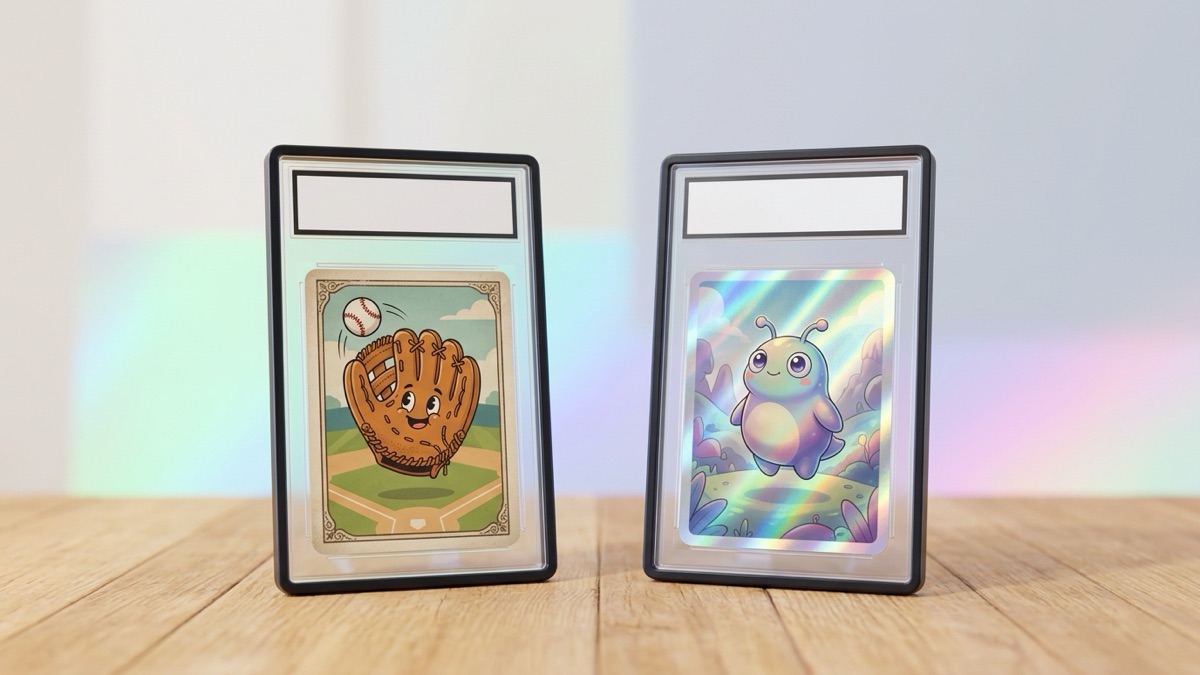
Collectors call SGC's slab the "tuxedo" because of the black insert that frames the card inside the clear holder. SGC's own terms refer to it as the black insert component in SGC's holder. The dark border hides nothing about the card but makes its edges and colors pop, a bit like a picture mat in a frame.
That look is a big part of SGC's fan club. Vintage collectors in particular like how a 60-year-old card looks sitting on black, and a bright holo card can look just as striking. It is pure taste, and it does not change the grade, but taste matters when a card will sit on your shelf for years.
How much does SGC grading cost?
SGC changed its service levels effective September 2, 2026, citing rapidly increasing demand and longer turnaround times. Here is its raw card grading table as of September 2026, from SGC's own pricing page:
| Max declared value | Standard (40+ business days) | Expedited (2 to 3 business days) |
|---|---|---|
| $1,500 | $50 | Not offered |
| $3,500 | $85 | $150 |
| $7,500 | Not offered | $250 |
| $20,000 | Not offered | $500 |
Higher values climb from there, up to $3,750 per card above $100,000. Sports Illustrated reported that the change more than doubled SGC's cheapest price, and SGC says further adjustments should be expected between late 2026 and early 2027.
For comparison, as of September 2026 PSA's cheapest open tier is Standard at $59.99 for cards up to $1,000, with an estimated 90 to 100 business days. SGC is still a little cheaper at the entry level and quicker on paper, but it is no longer the bargain it used to be. Our PSA grading cost guide covers PSA's tiers, and the free grading cost calculator adds up a whole box, shipping included.
Tip
Declare an honest value. SGC prices by maximum declared value, and graders generally move an undervalued card up a tier and bill the difference (PSA and CGC both say so on their price pages). A lowball declaration only delays the bill.
How long does SGC take?
As of September 2026, SGC estimates 40 or more business days for Standard and 2 to 3 business days for Expedited. Business days skip weekends and holidays, so 40 of them is roughly two months on the calendar.
SGC was candid about why it raised prices: it said its turnaround times had increased "beyond acceptable levels" and that it is hiring, adding space and investing in new technology to speed things up. Treat every estimate as an estimate, at SGC or anywhere else.
Is SGC good for Pokemon, or better for vintage sports?
It depends on what you want the slab to do.
Vintage sports cards. This is SGC's home turf. Sports Illustrated describes SGC as known for vintage, and many vintage buyers are happy to see a card in a tuxedo slab. PSA is still a benchmark in many vintage markets, so compare both before you decide.
Modern Pokemon. SGC grades Pokemon, and its slabs look great on a shelf. For selling, though, PSA dominates: Sports Illustrated reported that PSA handled 71.8 percent of the 26.8 million cards the major companies graded in 2025 and CGC 18.4 percent, leaving under 10 percent for everyone else, SGC included. Fewer buyers search for SGC Pokemon slabs by name.
There is no fixed price gap between an SGC slab and a PSA slab. It changes by card, grade and month, so check sold prices for your exact card in both.

Who should use SGC?
SGC makes sense if:
- You collect vintage sports cards and like where SGC sits in that market.
- You love the tuxedo look and plan to keep the card.
- Your card is clean and centered enough for a real shot at Pristine 10.
- You want a faster turnaround than PSA's Standard tier and the price gap is small for your card.
Look elsewhere if:
- You are selling modern Pokemon and want the biggest pool of buyers. PSA usually fits better, and our PSA vs CGC hub covers the two biggest graders.
- You want the cheapest possible slab for a stack of keepers. After the September 2026 change, SGC is no longer the low-cost option.
- You want subgrades on the label, which is Beckett's thing. See PSA vs BGS.
What should you check before sending cards to SGC?
Nobody can promise a grade at SGC or anywhere else. What you can do is check the card first: centering on both sides, sharp corners, clean edges, and a surface free of scratches and print lines when you tilt it under a bright light.
Try it
Measure your borders with the free card centering calculator. Anything worse than 55/45 rules out both SGC 10s on centering alone. It runs in your browser and never uploads the photo.
The MintGrade app walks you through the same checks: measure the centering on your own photo, check the corners, edges and surface under a lamp, and see whether grading pays off.
SGC is a dapper, long-running grader with a scale that rewards near-perfect cards and a slab that makes almost anything look good. After its September 2026 price change it is no longer the cheap option, so pick it for the right reasons: vintage cards, the tuxedo look, or a shot at Pristine. Measure first, check sold prices, then send the cards that deserve the suit.
The pictures in this guide are AI-generated illustrations of what to look for, not photos of real graded cards. Any fee or price in it carries the month it was checked against the grading company's own page or recent sold listings (sources below). MintGrade guides explain how grading works and help you decide what to submit. Only a grading company can assign a grade, and prices change daily, so check recent sold listings before you buy, sell or submit.
Questions collectors ask
What is the highest SGC grade?
Pristine 10. SGC describes it as a virtually flawless card with 50/50 centering and no visible wear under magnification. Just below it sits Gem Mint 10, which allows 55/45 centering.
How much does SGC grading cost?
As of September 2026, SGC's pricing page lists Standard at $50 per card for cards declared up to $1,500 and $85 up to $3,500, with an estimated 40 or more business days. Expedited, at 2 to 3 business days, starts at $150.
Is SGC good for Pokemon cards?
SGC grades Pokemon and other trading card games, and its slabs look sharp. For modern Pokemon you plan to sell, though, PSA reaches more buyers, so SGC tends to suit cards you want to keep or a collection you like to display.
Why are SGC slabs called tuxedo slabs?
SGC's holder uses a black insert around the card, which frames it like a tuxedo. Many vintage sports collectors love how the dark frame makes old cardboard stand out.
Who owns SGC?
Collectors, the company behind PSA, acquired SGC in February 2024, according to Sports Illustrated. SGC still grades under its own name, with its own scale and slab.
Where these facts come from
- SGC grading scale: gosgc.com/card-grading/scale
- SGC standard services and pricing: www.gosgc.com/card-grading/services-pricing
- SGC service level update (effective September 2, 2026): www.gosgc.com/service-level-update-2026-09-02
- SGC terms and conditions (black insert in SGC's holder): www.gosgc.com/terms
- SGC population report (data counted from 1998): www.gosgc.com/pop-report
- Sports Illustrated: SGC is the latest company to raise grading prices (September 2026): www.si.com/collectibles/sgc-latest-company-raise-grading-prices
- Collectors announcement on acquiring Beckett (lists SGC among Collectors subsidiaries): www.collectors.com/company-announcement
- Sports Illustrated: over 26 million cards graded in 2025: www.si.com/collectibles/over-26-million-cards-graded-in-2025-how-the-market-expl
- PSA trading card grading services and pricing: www.psacard.com/services/tradingcardgrading
- CGC Cards grading services and fees: www.cgccards.com/submit/services-fees/cgc-grading/
Read next

grading companies
PSA vs CGC for Pokemon Cards: Which Should You Pick?
grading companies
SGC vs PSA: Which Grader Is Better for Your Cards?

grading companies
TAG Grading Explained: Scores, Cost and TAG vs PSA

grading companies
PSA vs BGS: Beckett Subgrades vs the PSA Label

grading basics
PSA 9 vs PSA 10: Why One Point Changes the Price